In this series: Texas 2025-26 Enrollment.
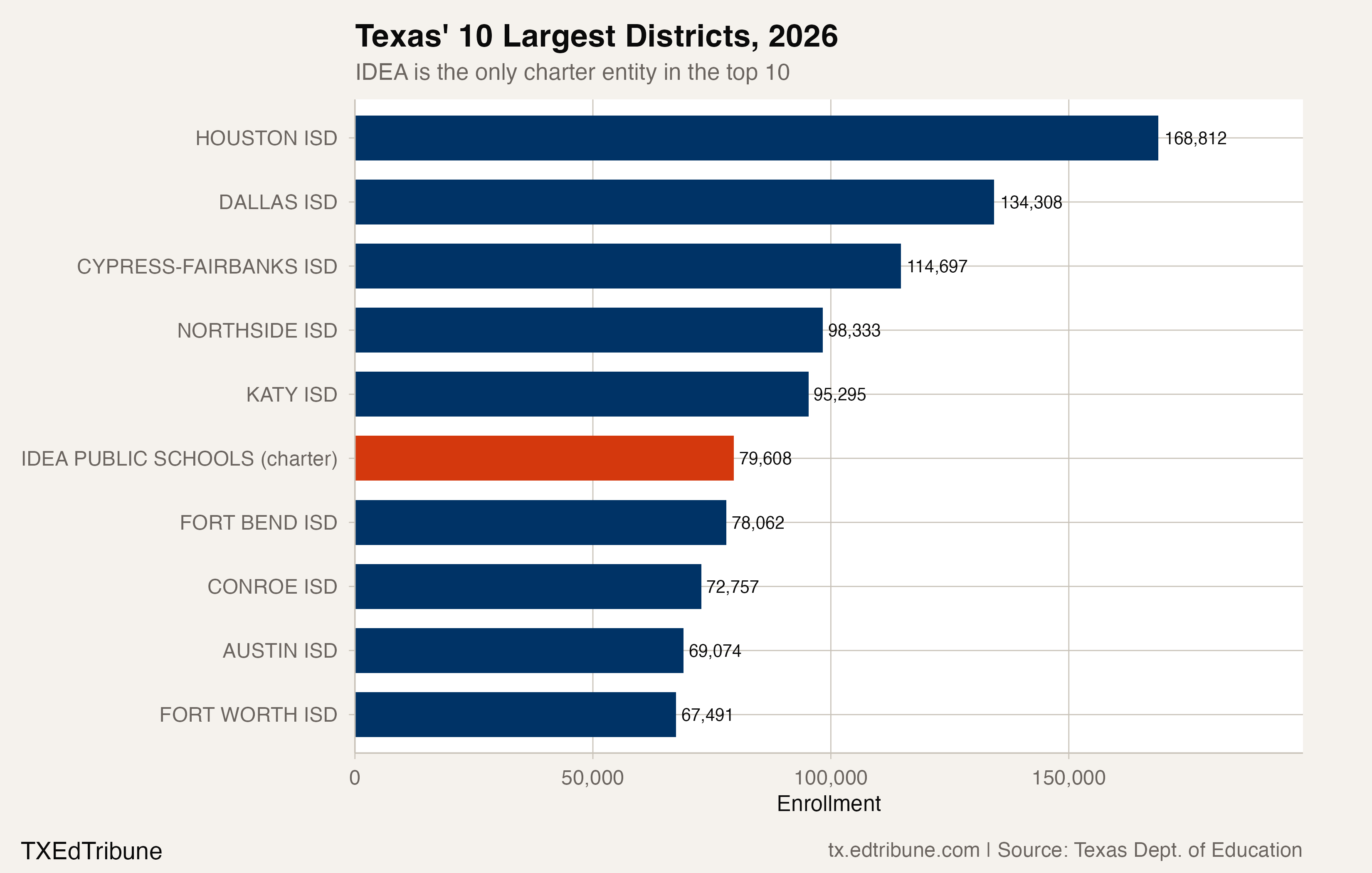
IDEA Public Schools↗ET reported 79,608 students last school year, 2025-26, placing it 6th among 1,200 districts and charter entities with published enrollment totals. It was larger than Austin ISD↗ET, at 69,074, and Fort Worth ISD↗ET, at 67,491.
Its size and its annual momentum now tell different stories. In the same recent report series, IDEA increased from 79,430 to 79,608 students, a gain of 178, or 0.2%. The gain was positive, but small relative to its existing enrollment. It does not establish that the network has reached a permanent ceiling.
IDEA was the only charter entity among the ten largest systems in that report. The ranking compares published district-level totals, rather than individual campuses or all of an operator's schools outside Texas.
A large expansion across the historical window
The complete historical performance reports follow the same Texas district identifier from 2004-05 through 2024-25. IDEA began that window with 659 students and ended with 79,430. The increase was 78,771 students, or 11,953.1%.
That is 120.5 times the starting enrollment. The very small starting base matters when reading the percentage: IDEA's expansion was large in students as well as in relative terms, but the two measures describe different aspects of its growth.
The compound annual growth rate was 27.1% across the historical window's twenty annual transitions. That calculation ends with the performance-report count in 2024-25. It does not append the newer report's endpoint to a historical growth rate.
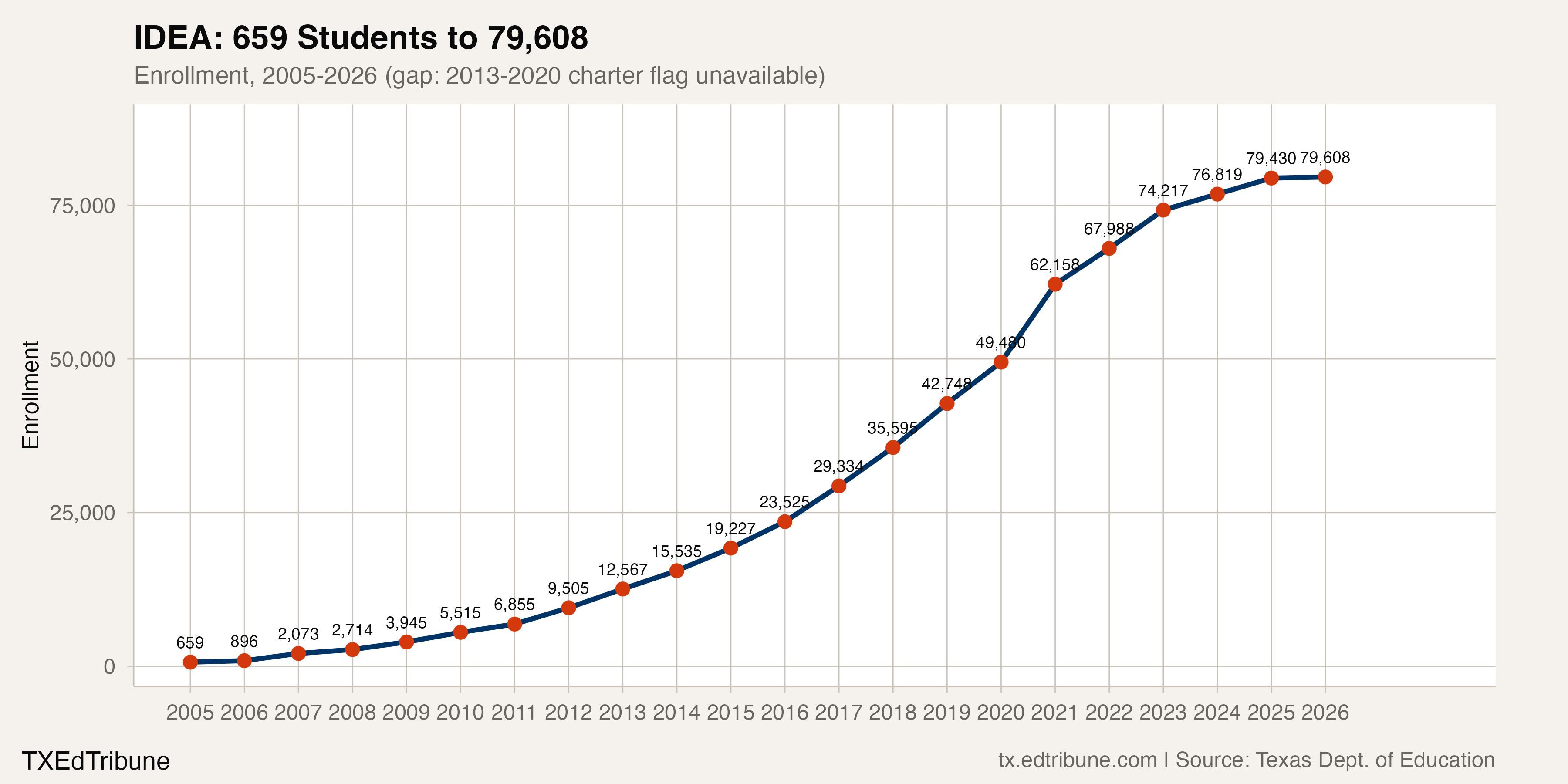
By 2011-12, IDEA reported 9,505 students and ranked 106th among 1,227 districts with positive reported totals in that year's files. A ranking in that older universe is a description of that year, rather than a comparison against today's roster of entities.
Every adjacent annual transition in the complete historical count panel was positive. The largest absolute annual addition was 12,678 students in 2020-21. The latest addition within that historical series was 2,611 in 2024-25, or 3.4%.
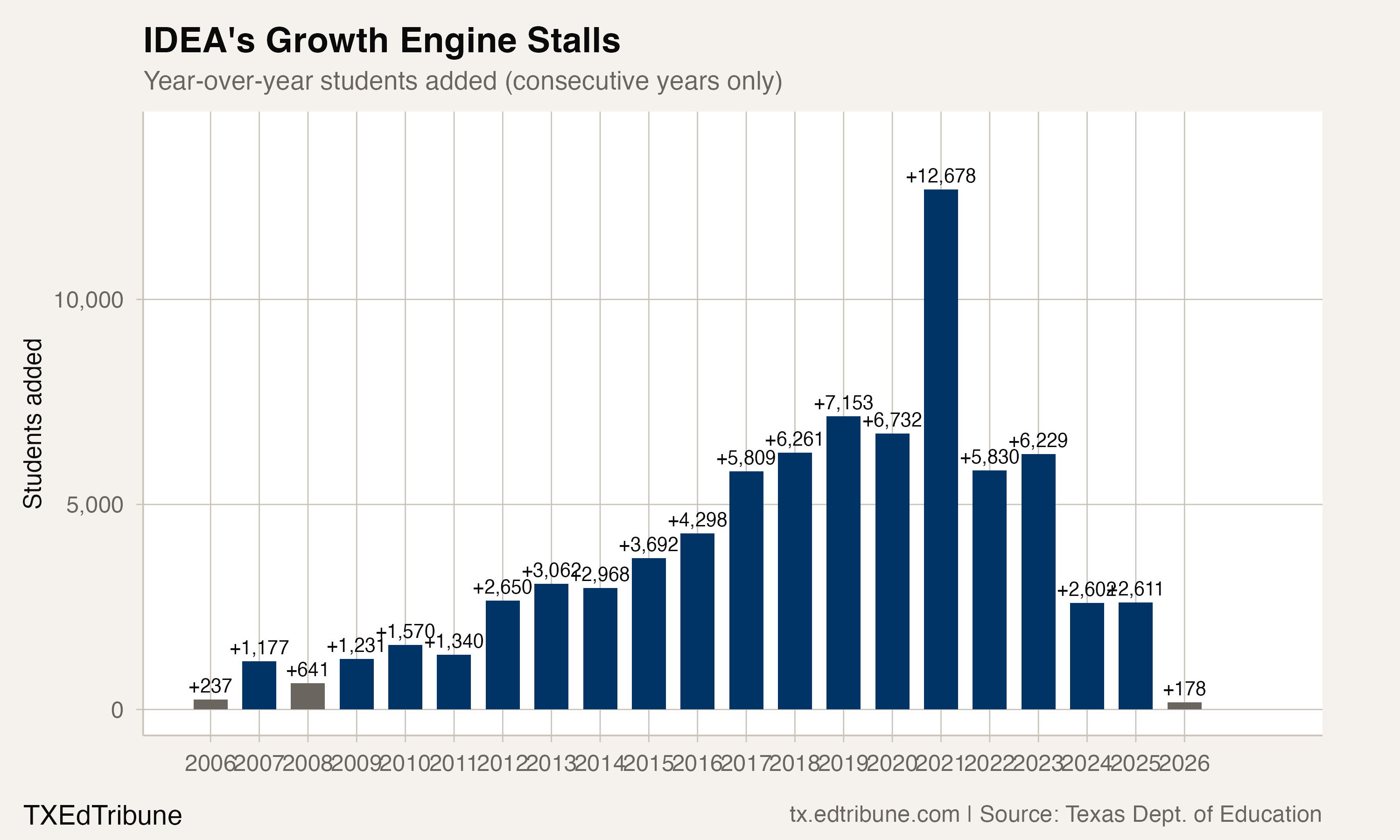
The newer enrollment reports separately show the small 2025-26 increase. Although IDEA's overlapping-year totals agree across these particular reports, that agreement alone does not establish comparability across the full historical series or the statewide reporting universe. The recent gain is therefore not ranked against all historical annual changes.
The charter sector is larger, with limits on the historical comparison
At the historical window's first endpoint, classified charter entities reported 66,073 students across 192 entities. Their enrollment represented 1.5% of the published statewide total. At its final endpoint, they reported 435,881 across 188 entities, or 7.9%.
The sector's classified district totals reconcile to the published state total at both endpoints. The endpoint contrast does not establish a smooth or uninterrupted sector trajectory between them: charter classifications are missing for eleven intervening reporting years. Those missing classifications cannot be treated as evidence that an entity was traditional rather than charter.
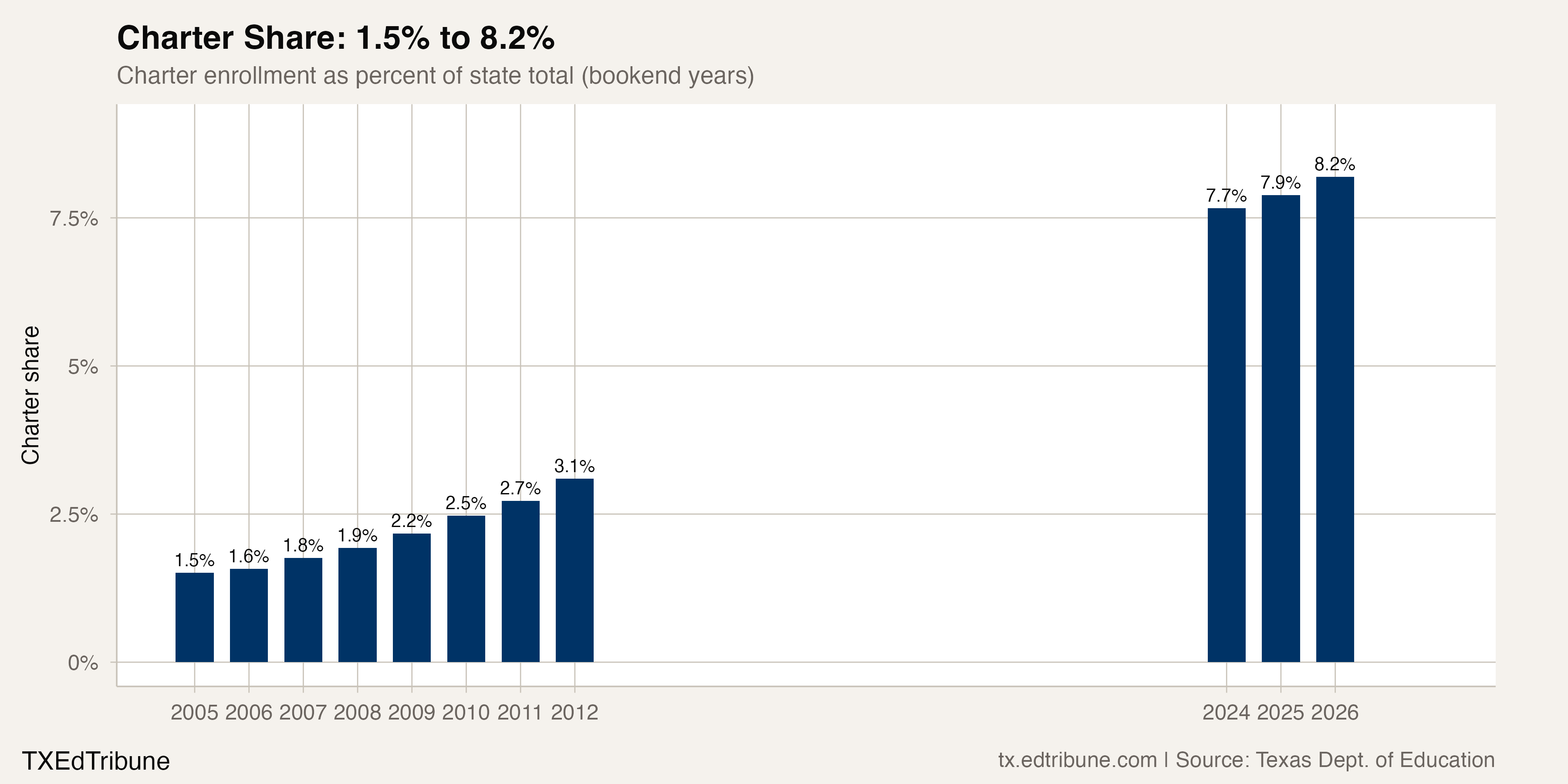
The separate newer report places charter enrollment at 446,633 students across 182 entities in 2025-26, or 8.2% of the published statewide total. That percentage uses the state's published denominator, rather than forcing the available district counts to sum to a replacement total.
The district totals fall short of the published state count by 32 students in the newer endpoint and by 76 in the prior year. The difference is small, but remains visible. These files do not establish what produced it, and the sector comparisons do not assign the missing students to either category.
Growth in one sector, a decline in the other
Within the newer report pair, charter enrollment increased by 10,649 students. Traditional district enrollment decreased by 87,218. The published statewide total decreased by 76,613.
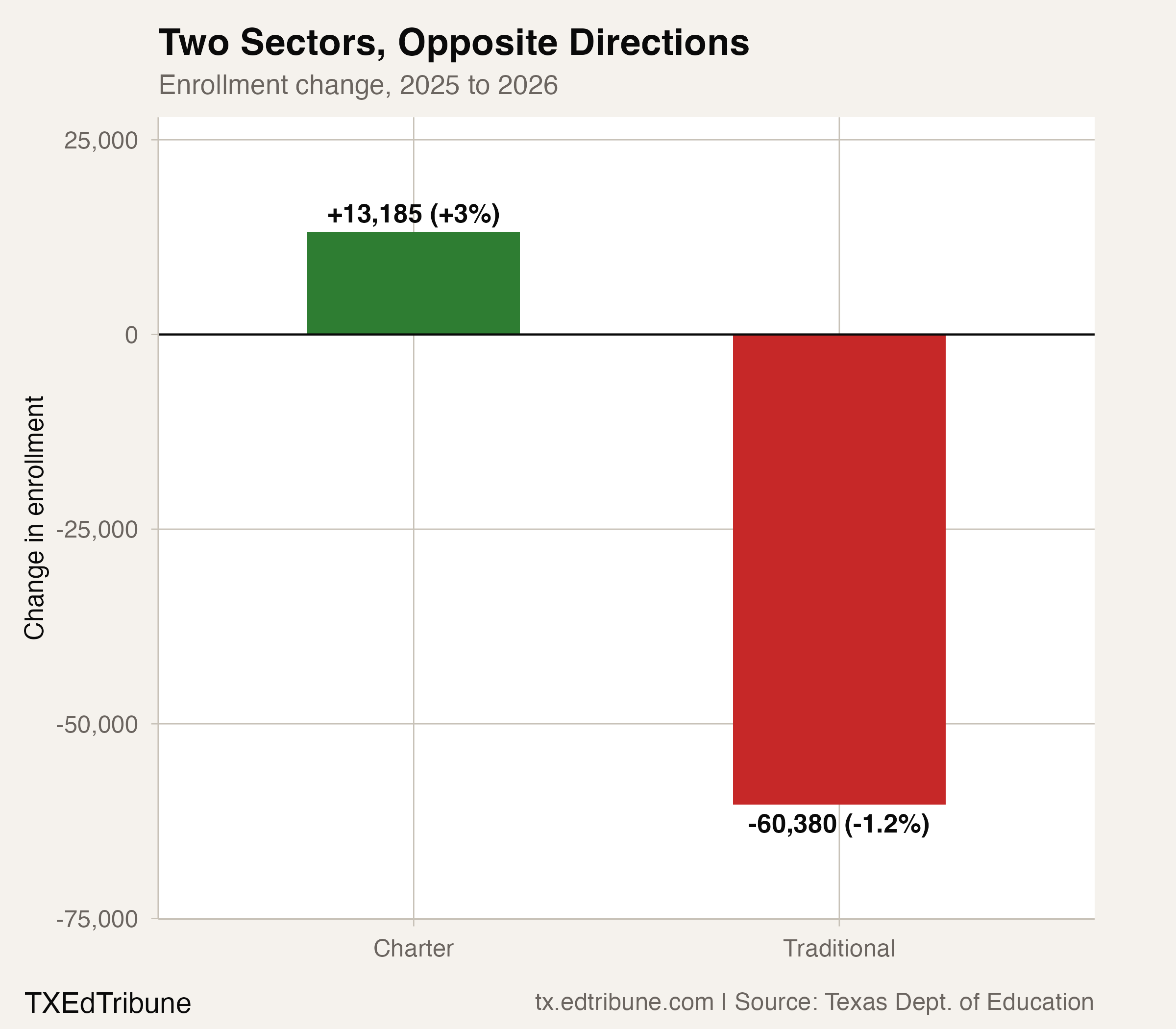
Those sector changes describe each year's classified roster, including entities that enter or leave the reporting universe. They are not a count of students transferring between sectors. Charter gains cannot simply be subtracted from traditional losses and interpreted as the effects of births, migration or private-school choices.
The largest charter entities also account for a substantial part of the sector. After IDEA, the newer report lists KIPP Texas with 31,611 students, International Leadership of Texas with 26,257, Uplift Education with 23,540 and YES Prep with 20,811. The five largest charter entities together reported 181,827 students.
Who is represented in IDEA's totals
IDEA's newer report recorded 67,858 Hispanic students, or 85.2% of its published total. Black enrollment was 6,056, or 7.6%, and White enrollment was 4,127, or 5.2%. All seven published race categories reconcile to IDEA's total, so these shares are not enlarged by excluding missing categories.
The historical 2024-25 report separately recorded 65,864 students classified as economically disadvantaged, or 82.9% of IDEA's published enrollment that year. TEA defines that category to include eligibility for free or reduced-price lunch or other public assistance. The newer report does not provide that count. The historical figure therefore describes that reporting year; it is not a current-year measure or a substituted 2025-26 figure.
The counts also cannot explain why IDEA's statewide growth slowed. In El Paso Matters' reporting on IDEA's El Paso campuses, regional director of operations Yanira Aguilar said, “We know that IDEA is not for every student.” That regional statement is an attributable perspective, rather than evidence identifying the cause of the statewide annual change.
IDEA remains larger than Austin and Fort Worth in the newer published totals, while its annual gain is much smaller than its historical expansion. Whether that smaller gain persists requires another comparable year of enrollment—not a forecast built from a single change.
Source: Texas Education Agency annual performance reports and Student Enrollment Reports.
Detailed code that reproduces the analysis and figures in this article is available exclusively to EdTribune subscribers.
Discussion
Sign in to join the discussion.
Loading comments...