In this series: Texas 2025-26 Enrollment.
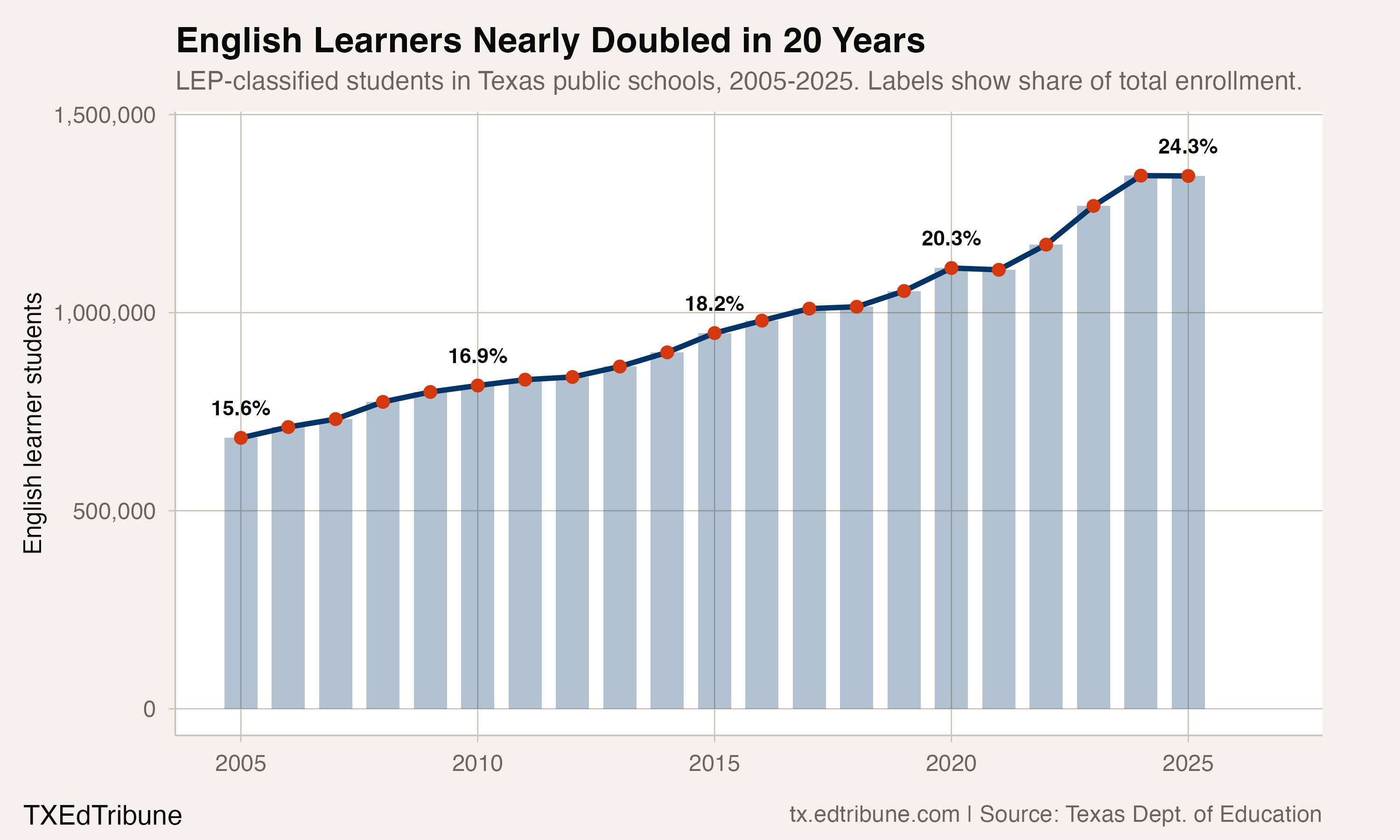
Texas reported 1,345,031 students in its English-learner category in 2024-25, or 24.3% of the published statewide enrollment total. That was close to one-quarter of all students in that reporting year.
The full historical window began with 684,007 English learners in 2004-05. The reported count increased by 661,024, or 96.6%, by 2024-25. Over the same window, total enrollment rose 26.2%.
These figures describe 2024-25 and earlier school years. They are not a live count for the 2026-27 school year now underway.
Classification and program enrollment are different measures
TEA's glossary explains that emergent bilingual, English learner and the earlier term limited English proficient describe the same student group. Its current category includes students whose parents declined bilingual or English-as-a-second-language services. A count in that category therefore does not establish enrollment in a particular instructional program.
The percentages here divide reported English-learner counts by published enrollment totals for the same entity and year. At the statewide endpoints, the shares were 15.6% and 24.3%. The 2024-25 denominator was 5,530,499 students.
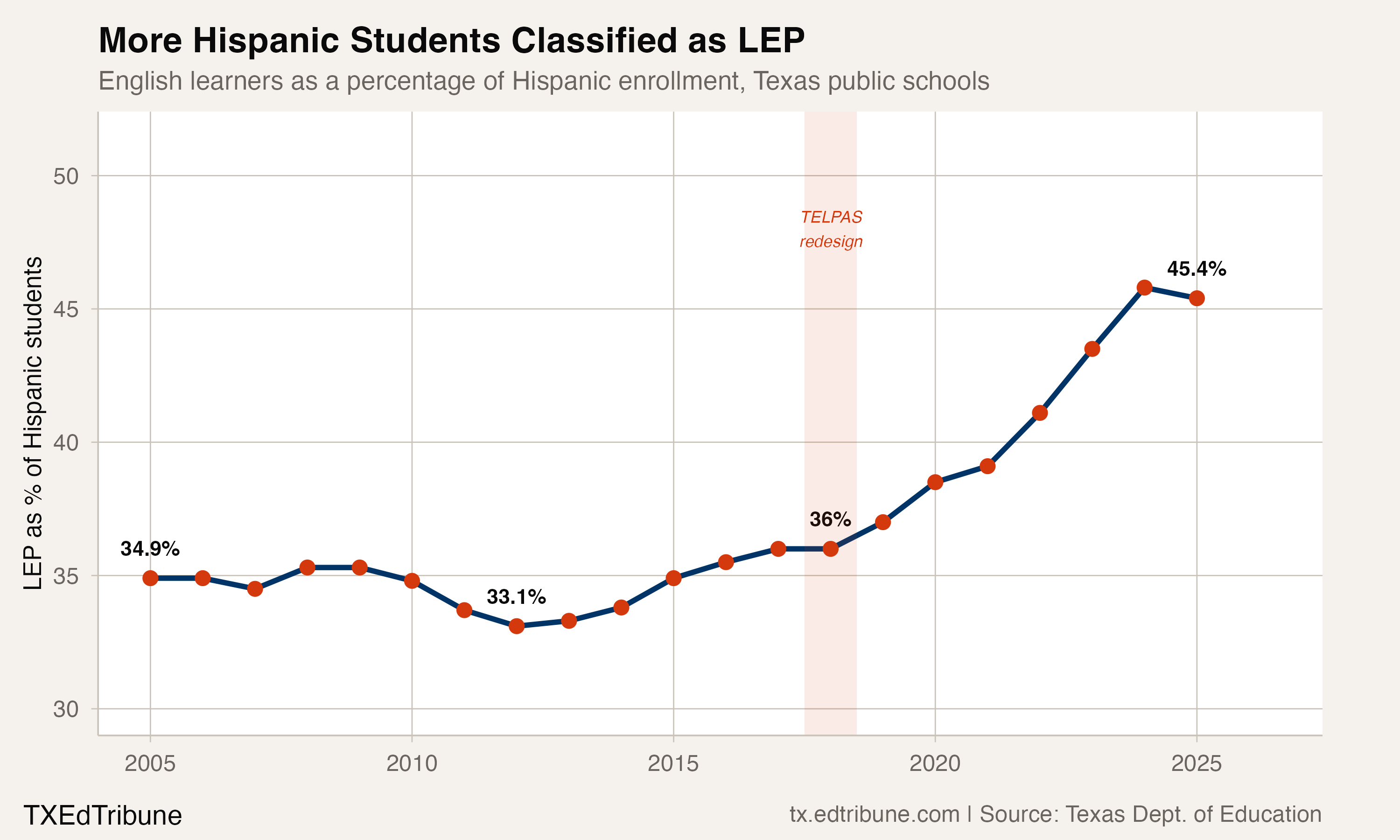
The statewide English-learner and Hispanic counts are separate marginal counts. Dividing one by the other would not reveal the share of Hispanic students classified as English learners. These comparisons contain no ethnicity-by-English-learner intersection, and this article makes no such inference.
Larger count gains alongside slower overall growth
Between 2019-20 and 2024-25, the reported English-learner count increased by 232,357, while published total enrollment increased by 51,326. The first count change was 4.5 times the second.
That comparison is about two aggregate changes. It does not mean all added English learners were new students entering Texas schools or that they explain all net enrollment growth. TEA distinguishes currently identified students from former English learners who have been reclassified. These aggregate observations do not follow individual students through that process.
The largest annual increase in the complete historical window was 97,747 in 2022-23. In 2024-25, the count fell by 869, from 1,345,900 to 1,345,031. Its published-total share moved from 24.4% to 24.3%.
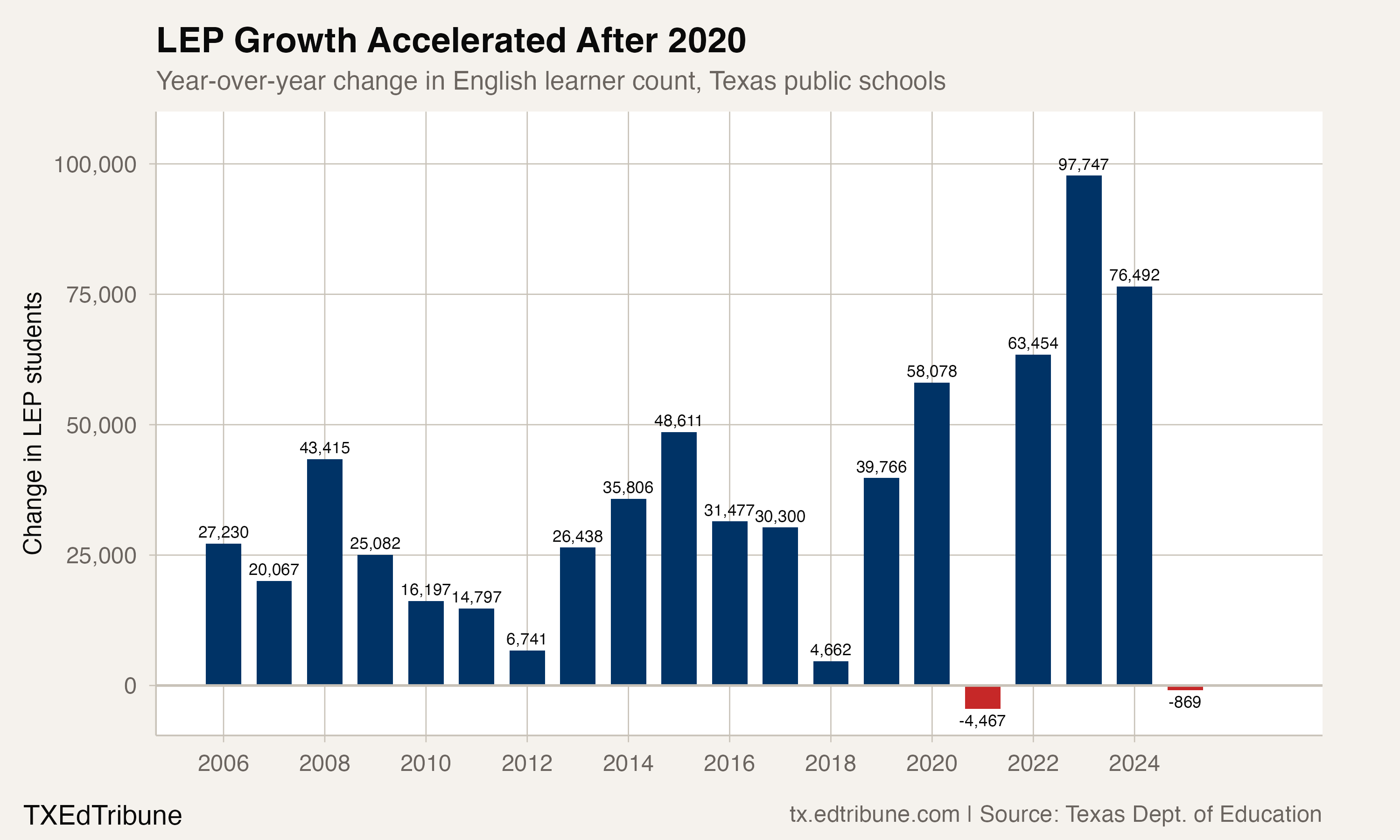
The latest small decline is an observation, not evidence of a plateau that will persist. Immigration, identification and reclassification explanations would require their own evidence; the reported counts do not distinguish their contributions.
District shares vary widely
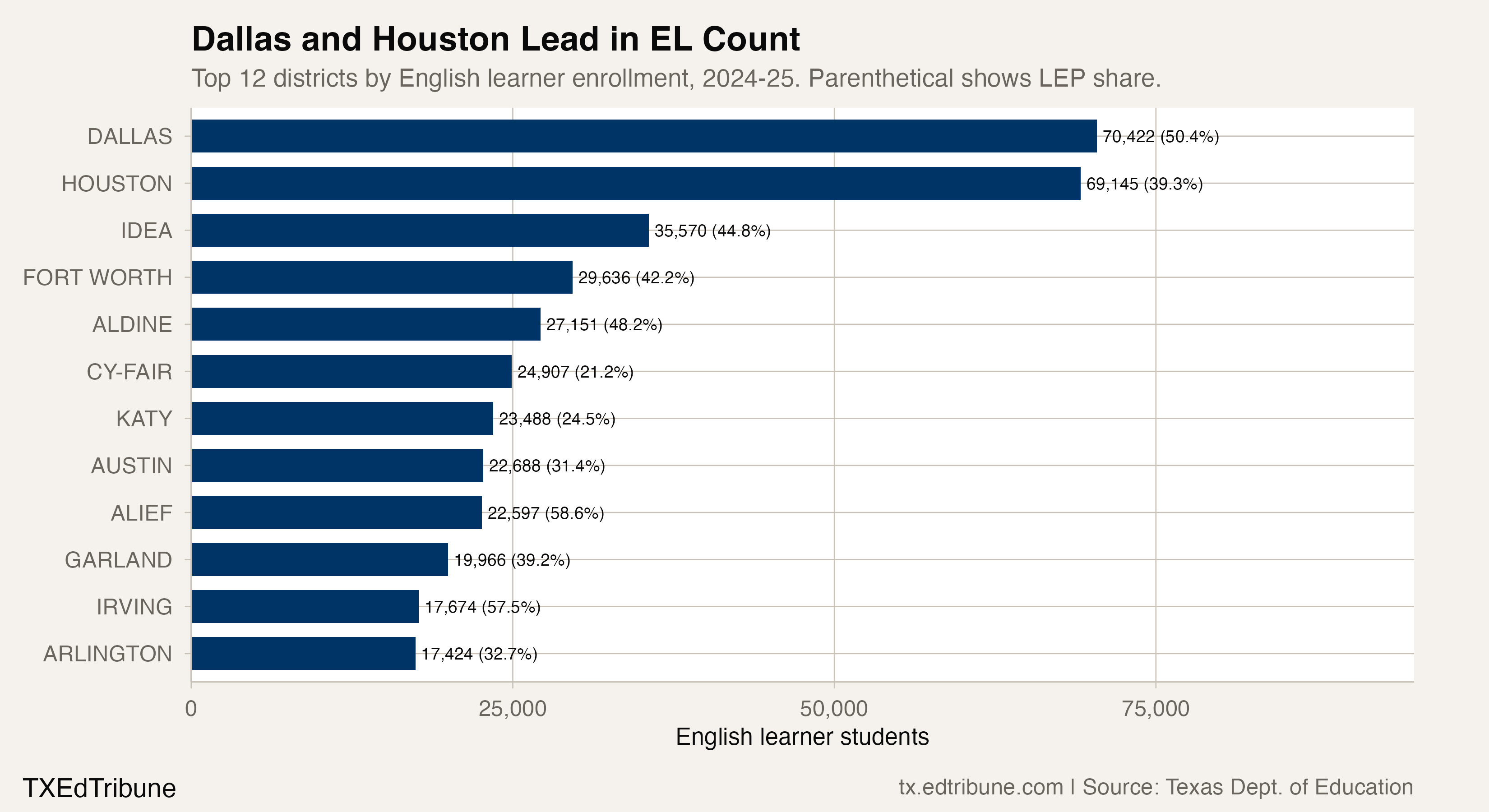
Dallas ISD↗ET reported 70,422 English learners in 2024-25, or 50.4% of its published district total. Its historical 2004-05 share was 30.6%.
Houston ISD↗ET reported 69,145, or 39.3%, in 2024-25. Its count was lower than its 2019-20 count, even though its published-total share was higher. Count growth and share growth are different comparisons.
The latest reported shares were 62.8% in Cleveland ISD↗ET, 58.6% in Alief ISD↗ET and 57.5% in Irving ISD↗ET. These district-wide shares use the student classification TEA describes, rather than enrollment in a particular instructional program.
For the statewide district comparison, all 1,208 published district total rows in the 2024-25 files had a positive finite total and a finite English-learner count between zero and that total. No district was excluded by that control. Among them, 54 had a reported English-learner share above half.
The twelve largest reported counts in this eligible universe totaled 380,668 students, or 28.3% of the published statewide English-learner count. The statewide denominator is the state's own reported count, not a replacement assembled by summing district records.
Different selected districts, different recent count changes
Katy ISD↗ET reported 4,678 English learners in 2004-05 and 23,488 in 2024-25; its shares were 10.6% and 24.5%. Cypress-Fairbanks ISD↗ET reported 10,821 and 24,907, with shares of 13.7% and 21.2%.
Prosper ISD↗ET went from 956 English learners in 2019-20 to 4,316 in 2024-25. Its published-total share moved from 5.7% to 13.7%. Round Rock ISD↗ET reported shares of 10.8% and 19.5% over that same shorter window. Fort Worth ISD↗ET reported 42.2% at the later endpoint.
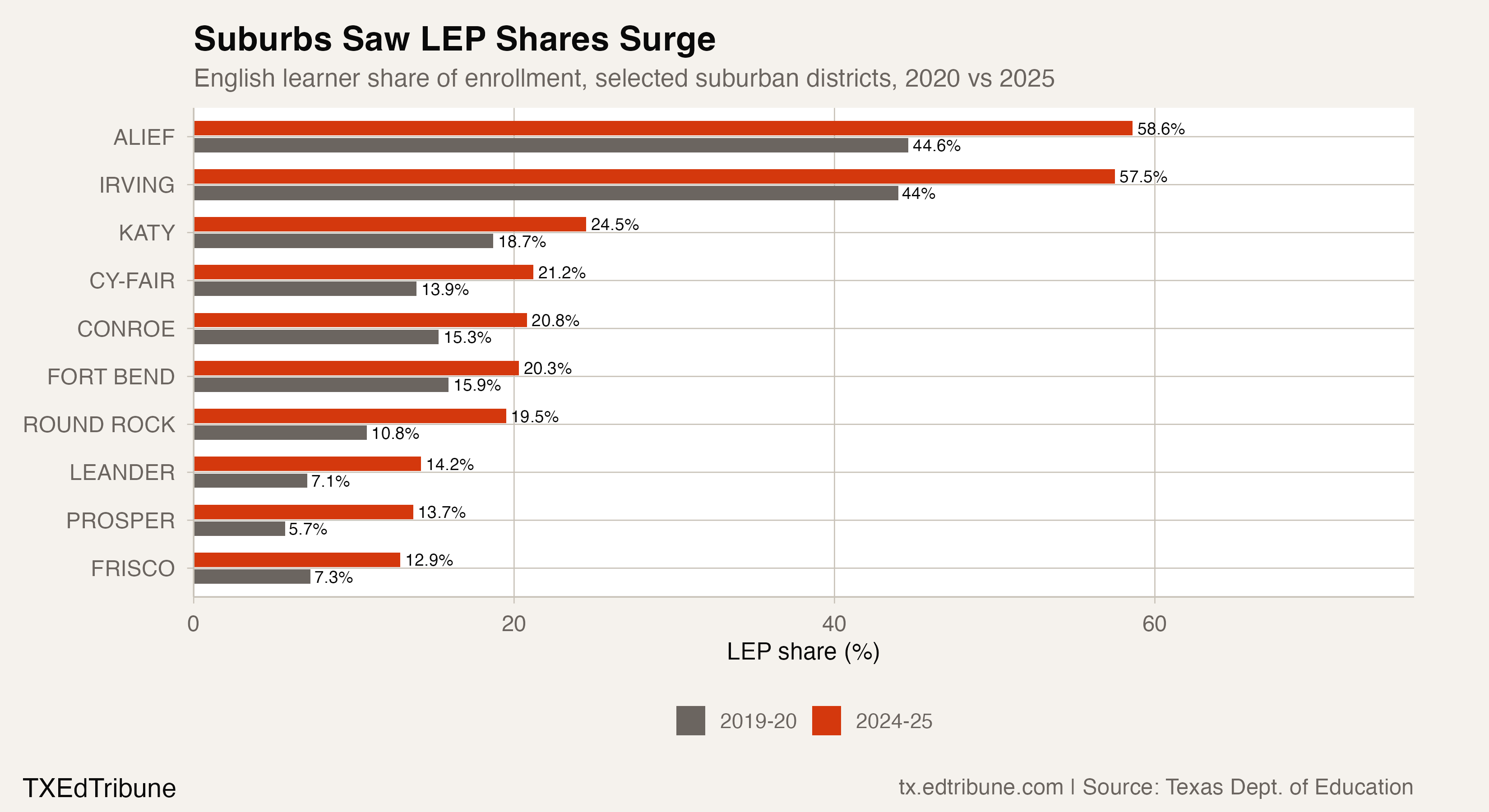
These selected district comparisons show reported counts and proportions. They do not establish where families settled, whether staffing was adequate, which program models students received, or what those services cost.
The historical increase and the small final-year decline are both visible in the data. Neither supplies a forecast for the next school year or identifies the policy or demographic mechanism behind the change.
Sources: Texas Education Agency historical annual performance reports, including earlier AEIS reports. All numeric comparisons use reported English-learner counts and published enrollment totals within the 2004-05 through 2024-25 historical window.
Detailed code that reproduces the analysis and figures in this article is available exclusively to EdTribune subscribers.
Discussion
Sign in to join the discussion.
Loading comments...