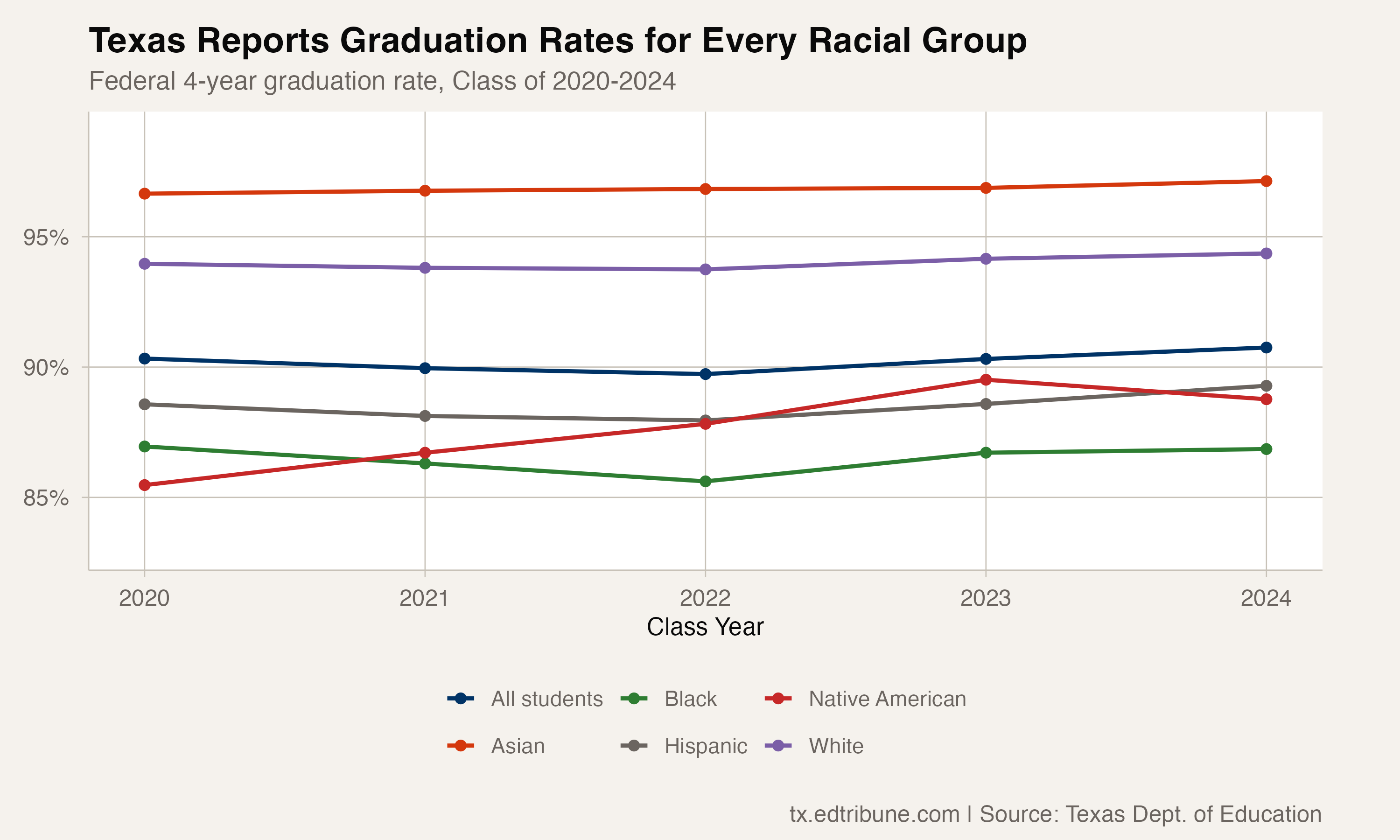
The Texas Education Agency publishes a four-year graduation rate for every racial and ethnic group it tracks, and it has done so in every year from the Class of 2020 through the Class of 2024. For Black students, that rate was 86.9% in 2024. For Native American students, it was 88.8%. Neither figure is missing, suppressed, or hidden. Both sit in the state's downloadable graduation files alongside the white rate of 94.4% and the statewide rate of 90.7%.
What the data shows is not an absence. It is a gap that has refused to close.
A gap that will not move
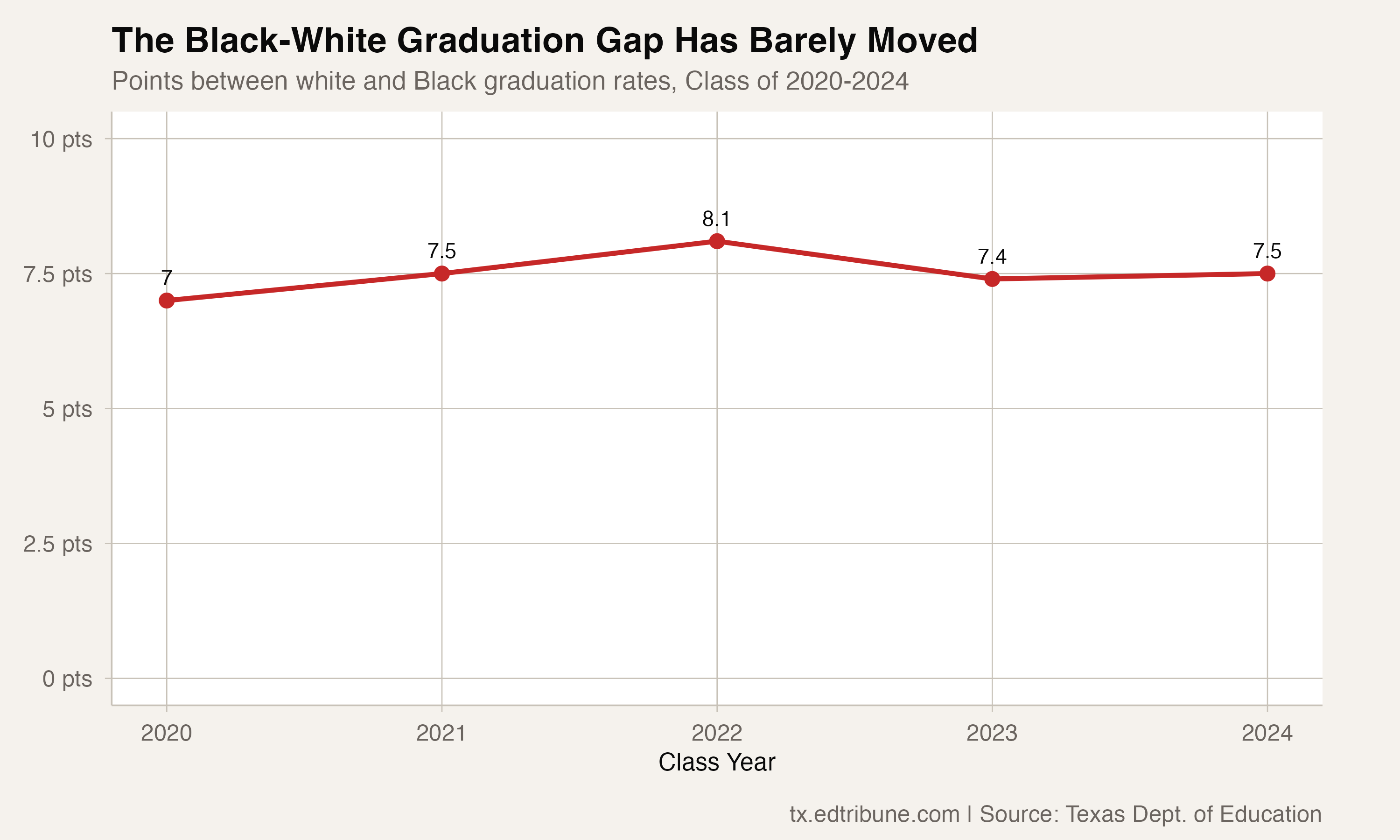
Black students in Texas graduated at 87.0% for the Class of 2020 and 86.9% for the Class of 2024. Five years, one-tenth of a point. Over the same stretch the white rate edged up from 94.0% to 94.4%. Because one line drifted up while the other held flat, the distance between them widened slightly, from 7.0 points in 2020 to 7.5 points in 2024. It touched 8.1 points in 2022 before easing back. The Black-white graduation gap in Texas is not narrowing. It is holding.
That stability is its own finding. Graduation rates for most Texas groups improved modestly after the pandemic dip. Black students did not participate in that recovery. Their rate fell to 85.6% for the Class of 2022, the low point of the window, and climbed back to almost exactly where it started. A gap that neither grows nor shrinks is easy to overlook precisely because nothing appears to be happening.
The bright spot the same data holds
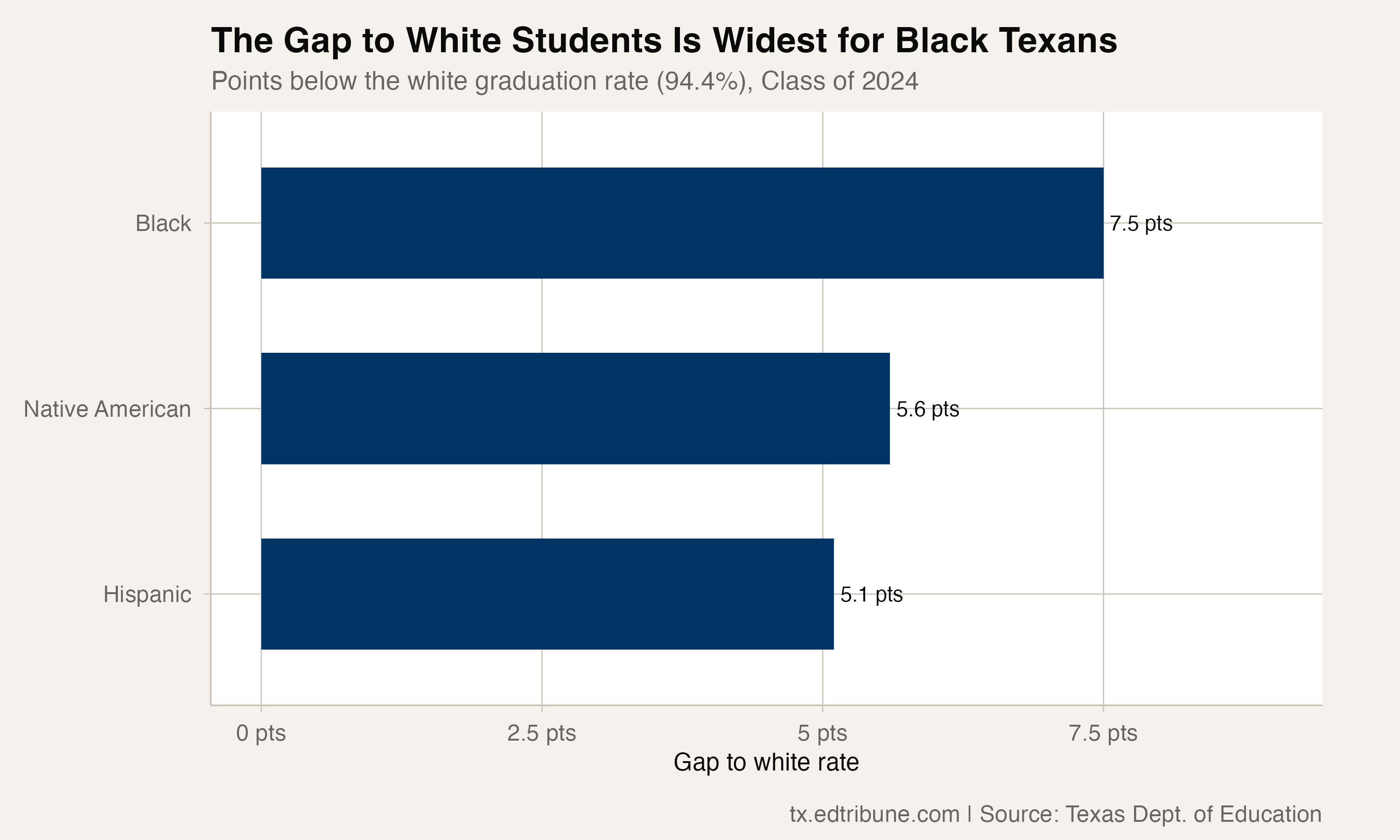
The story is different for Native American students, a smaller group whose rate has moved in the right direction. It climbed from 85.5% for the Class of 2020 to 88.8% for the Class of 2024, a gain of 3.3 points, the largest improvement of any racial group in the window. That leaves Native American students 5.6 points below the white rate in 2024, down from a wider gap five years earlier. Hispanic students, who make up roughly half of Texas enrollment, graduated at 89.3% in 2024, 5.1 points below white students.
Among the racial groups, then, the widest gap to white students belongs to Black Texans, and it is the one that has moved least.
Where the gap lives
The statewide Black rate of 86.9% masks sharp variation across the districts that enroll the most Black students. In Houston ISD↗ET, Black students in the Class of 2024 graduated at 83.7%, on a cohort of roughly 2,900, the largest Black graduating class in the state. Dallas ISD↗ET posted 82.6% on a cohort of about 1,900. Fort Worth ISD↗ET came in at 76.4%, more than ten points below the state's Black rate. Aldine ISD↗ET, a Houston-area district, graduated 83.9% of its Black students.
Not every large district trails. Cypress-Fairbanks ISD↗ET, a suburban district northwest of Houston with a Black graduating cohort of nearly 1,900, reached 89.8%, above the statewide Black rate and within striking distance of the state average for all students. The spread among these five districts, from 76.4% to 89.8%, is wider than the statewide Black-white gap itself. Where a Black student attends high school in Texas shapes the odds as much as the statewide number suggests.
What the data can and cannot say
The graduation files record the pattern. They do not explain it. The state's four-year cohort rate cannot say why Black graduation rates have been flat while other groups recovered, whether the concentration of lower rates in the largest urban districts reflects school practice, cohort composition, or the movement of students across district lines. Those are the questions the numbers raise and cannot answer on their own.
What the files do settle is a more basic point. The rates exist. Texas measures the Black-white graduation gap, publishes it every year, and the record shows a gap that has held near 7.5 points for half a decade while the state's overall rate quietly improved.
Source: Texas Education Agency four-year graduation rate data.
Detailed code that reproduces the analysis and figures in this article is available exclusively to EdTribune subscribers.
Discussion
Sign in to join the discussion.
Loading comments...