Correction (October 8, 2026): The statewide comparison now uses the published State graduation cohort and rounded rate. The earlier description of that benchmark as enrollment-weighted was incorrect. The comparison is limited to named districts and identifies the English-learner cohort used below.
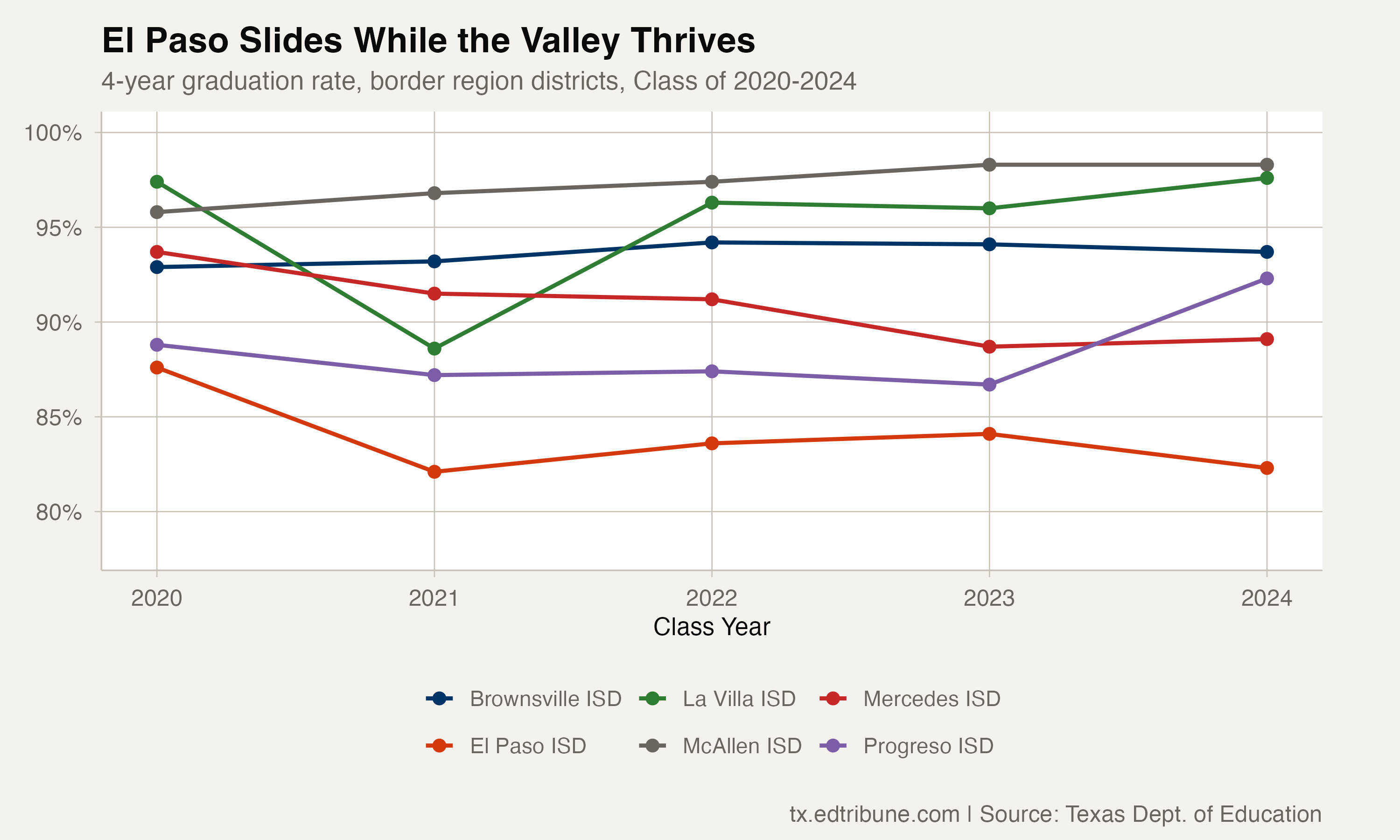
El Paso ISD↗ET and McAllen ISD↗ET had different graduation trajectories across the classes of 2020–2024.
El Paso ISD's rate fell from 87.6% to 82.3%, a decline of 5.3 percentage points. McAllen ISD climbed from 95.8% to 98.3%, a gain of 2.5 points. The gap between the districts widened from 8.2 points to 16.0 points across those five classes.
McAllen's reported subgroup rates
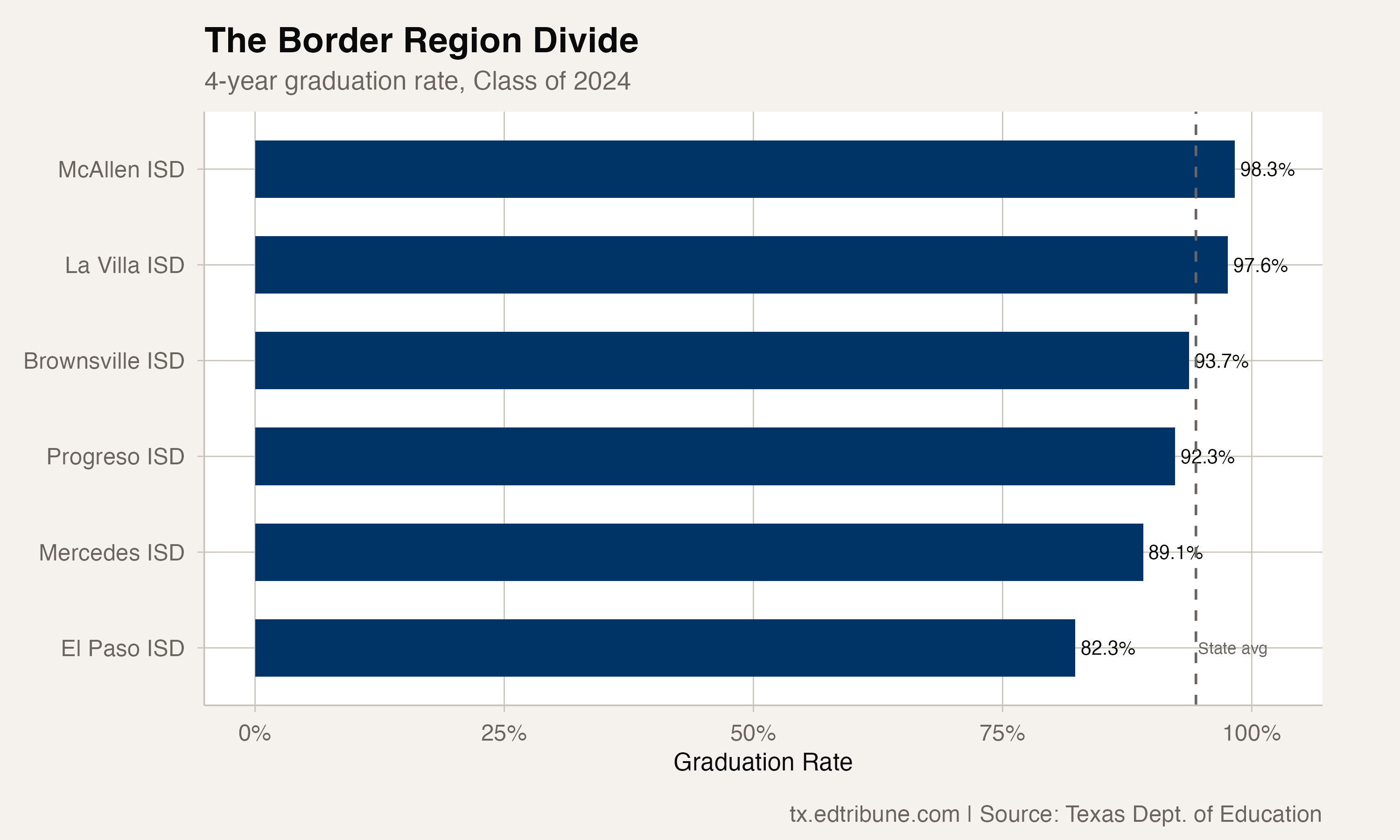
McAllen's Class of 2024 graduation rate was above the published statewide rate of 90.7%. Brownsville ISD↗ET reported 93.7%, also above the state rate.
McAllen's economically disadvantaged students graduated at 98.0%. Students identified as English learners in their last year posted 97.6%, and its at-risk students reached 98.1%. Each of those groups had a rate above the statewide rate for all students. Students receiving special education services had a lower rate, at 85.8%.
The English-learner comparison uses the last-year group in TEA’s district data dictionary, rather than the broader group identified at any time in high school.
Four selected groups declined in El Paso
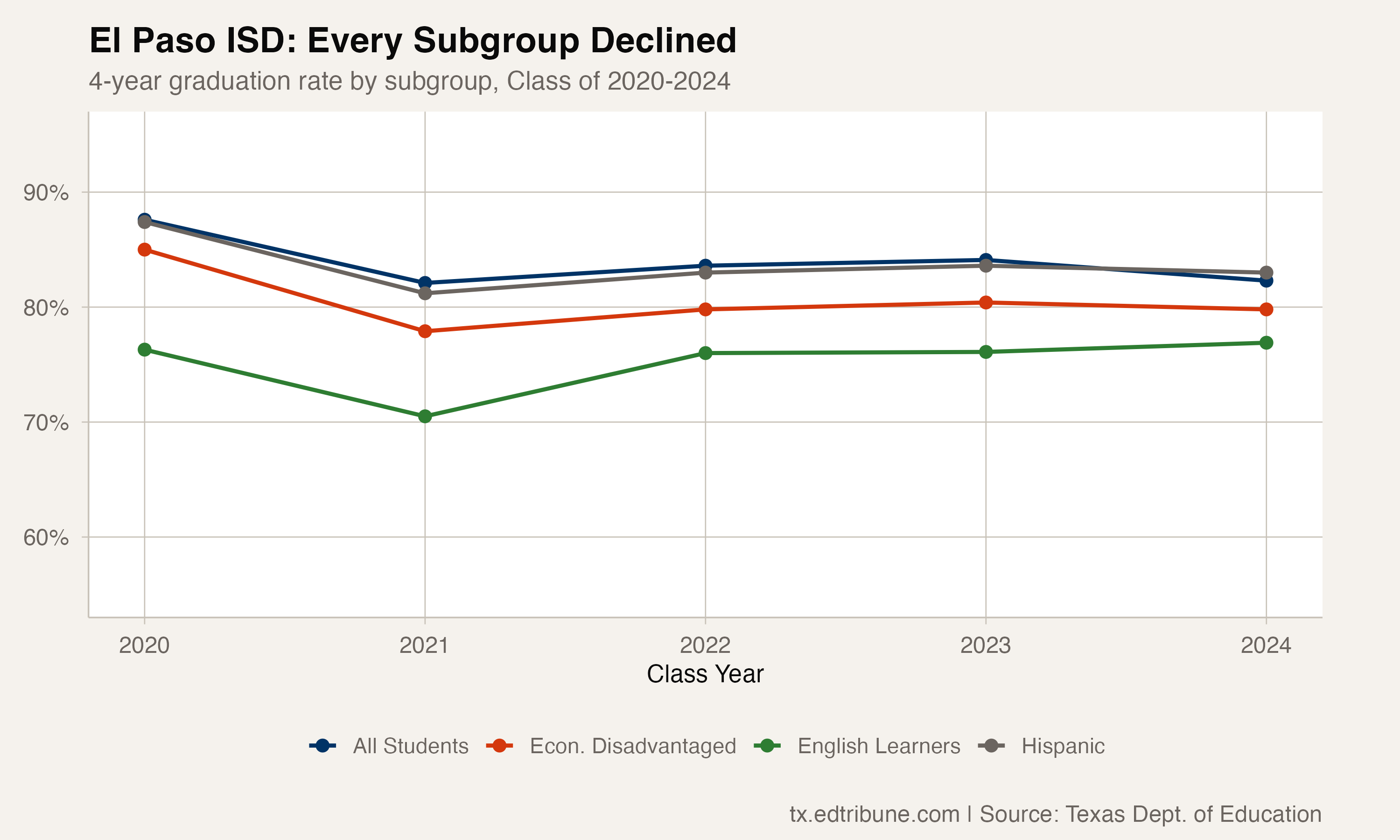
El Paso's all-student, Hispanic, economically disadvantaged and at-risk rates each fell between the two classes. These groups overlap, so they are comparisons of reported rates rather than separate parts of a graduating class.
Hispanic students' rate fell from 87.4% to 83.0%. Economically disadvantaged students' rate fell from 85.0% to 79.8%. At-risk students' rate fell from 83.7% to 80.0%. The rate for students identified as English learners in their last year rose from 76.3% to 76.9%.
The at-risk rate fell from 83.7% to 74.7% for the Class of 2021, rose to 80.8% by 2023, then fell to 80.0% in 2024. The records show the changes; they do not establish their causes.
The comparison has limits
The districts differ in size. Their published enrollment totals for the 2023–2024 school year were about 49,000 students in El Paso ISD and 20,000 in McAllen ISD. Size alone does not establish an explanation for the graduation-rate gap.
Among the seven named urban districts in this comparison—Houston, Dallas, Austin, Fort Worth, San Antonio, El Paso and Arlington—El Paso's Class of 2024 rate of 82.3% was lowest. Fort Worth reported 82.6%, Houston 84.3% and Dallas 84.4%. These comparisons use reported rates for the same class and do not fill missing subgroup records.
The Texas Education Agency's graduation records provide the federal four-year cohort measures used here. They follow a starting ninth-grade class rather than dividing graduates by annual enrollment.
Detailed code that reproduces the analysis and figures in this article is available exclusively to EdTribune subscribers.
Discussion
Sign in to join the discussion.
Loading comments...