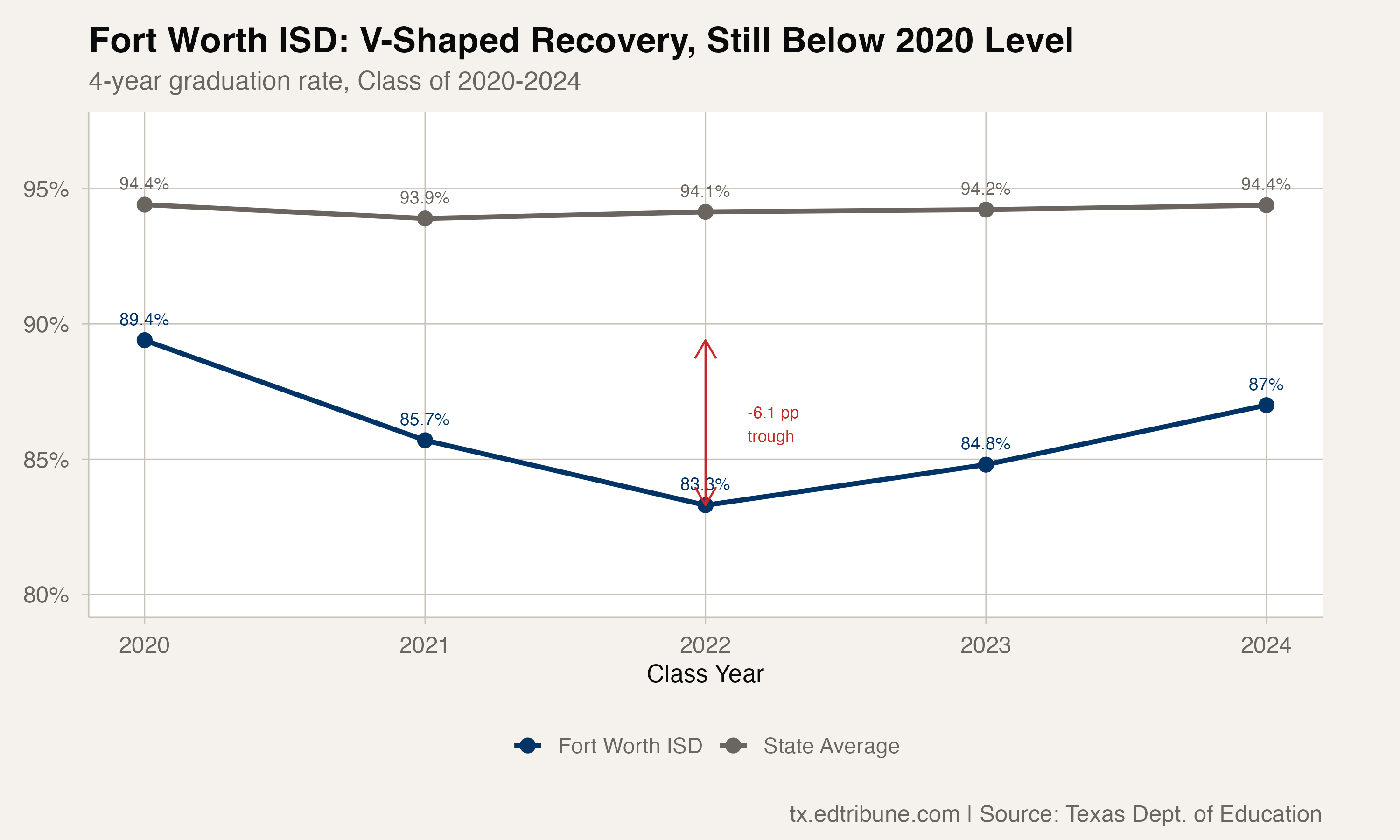
Fort Worth ISD↗ET reported a graduation rate of 81.0% for the Class of 2022, down 4.4 percentage points from its 85.4% rate for the Class of 2020.
By the Class of 2024, the rate had risen to 82.6%. That was still 2.8 points below the starting rate and 8.1 points below the statewide rate of 90.7%.
The decline and partial recovery
The rate fell from 85.4% for the Class of 2020 to 84.0% for the Class of 2021, then to 81.0% for the Class of 2022. The decline across those classes was 4.4 points. Over the same interval, Houston's rate changed by -0.3 points, Dallas's by -2.2 points and San Antonio's by +1.5 points.
The records establish the rate changes. They do not establish why the districts followed different paths.
The subgroup picture
Fort Worth's Hispanic graduation rate fell from 87.8% to a low of 82.9% within the five-class window and ended at 84.3%. Its White rate fell from 86.4% to a low of 82.4% and ended at 82.9%. Its Black rate fell from 78.6% to a low of 74.3% before ending at 76.4%.
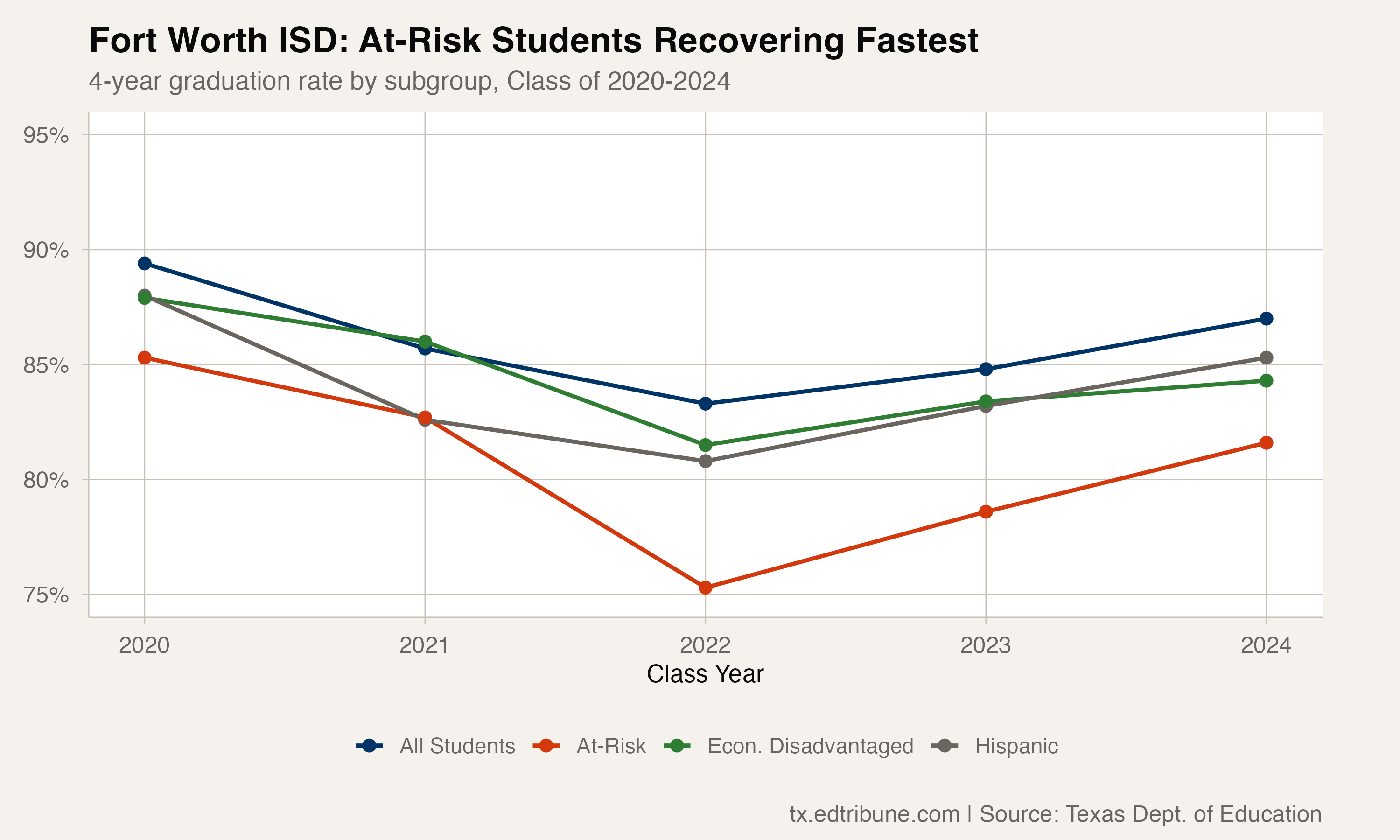
The English learner rate rose from 71.3% to 81.5%. The at-risk rate was nearly flat, moving from 80.4% to 80.3%. Economically disadvantaged students' rate fell from 84.8% to a low of 79.8%, then ended at 81.8%, still 3.0 points below its starting rate. These groups overlap.
A fixed peer comparison
Recovery here means the Class of 2024 rate minus each district's lowest reported rate across the classes of 2020–2024. It does not describe a change from an identical starting class in every district.
Fort Worth's gain from its trough was 1.6 points. Dallas ISD↗ET gained 4.6 points, San Antonio ISD↗ET gained 3.2 points, Houston ISD gained 2.6 points and El Paso ISD gained 0.2 points. Austin ISD's Class of 2024 rate was the lowest in that five-class window.
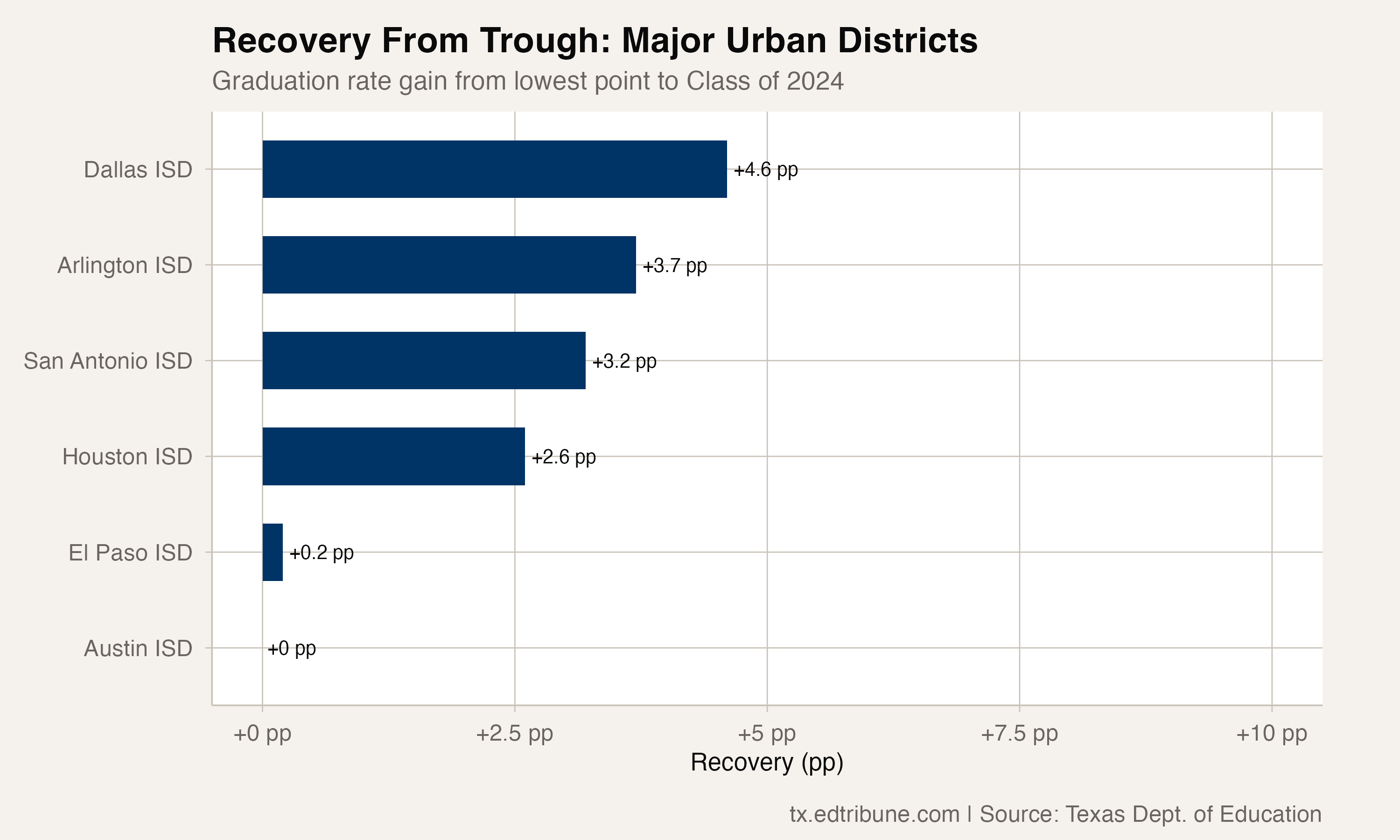
The comparison covers these six named districts and their reported rates. Houston, Dallas and San Antonio ended the window above their starting rates; Fort Worth, El Paso and Austin did not. A later graduating class would be needed to establish whether Fort Worth's partial recovery continued.
The Texas Education Agency's graduation records provide the four-year cohort measures used here.
Detailed code that reproduces the analysis and figures in this article is available exclusively to EdTribune subscribers.
Discussion
Sign in to join the discussion.
Loading comments...