Correction (July 24, 2026): An earlier version of this article reported statewide subgroup graduation rates drawn from an unweighted average of district rates. Under Texas's enrollment-weighted federal rates, English learners climbed from 78.1% to 85.7% (a 7.6-point gain, not the 4.2 points first reported), and the gap with all students narrowed from 12.2 to 5.0 points. The year-over-year path, the subgroup comparison, and the gap section have been corrected. District-level figures were unaffected.
While Texas's overall graduation rate barely moved over five years, holding in a narrow band between 89.7% and 90.7%, one subgroup was quietly posting the largest improvement in the state.
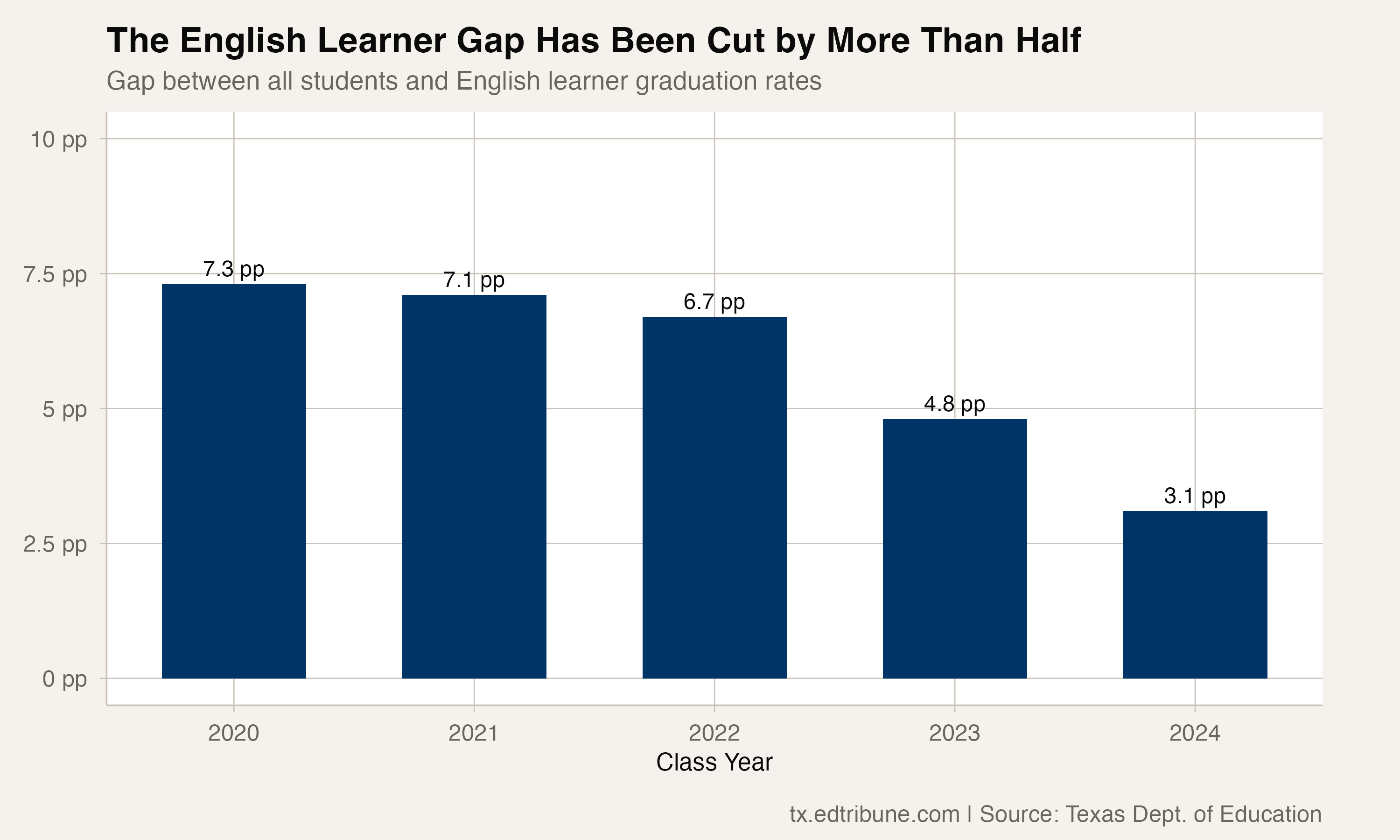
Students classified as English learners climbed from 78.1% (Class of 2020) to 85.7% (Class of 2024), a gain of 7.6 percentage points. The gap between English learner graduation rates and the rate for all students narrowed from 12.2 points to 5.0 points, a reduction of more than half. Texas enrolls one of the largest emergent bilingual populations in the country, so a gain of this size moves a lot of students across the stage.
The acceleration
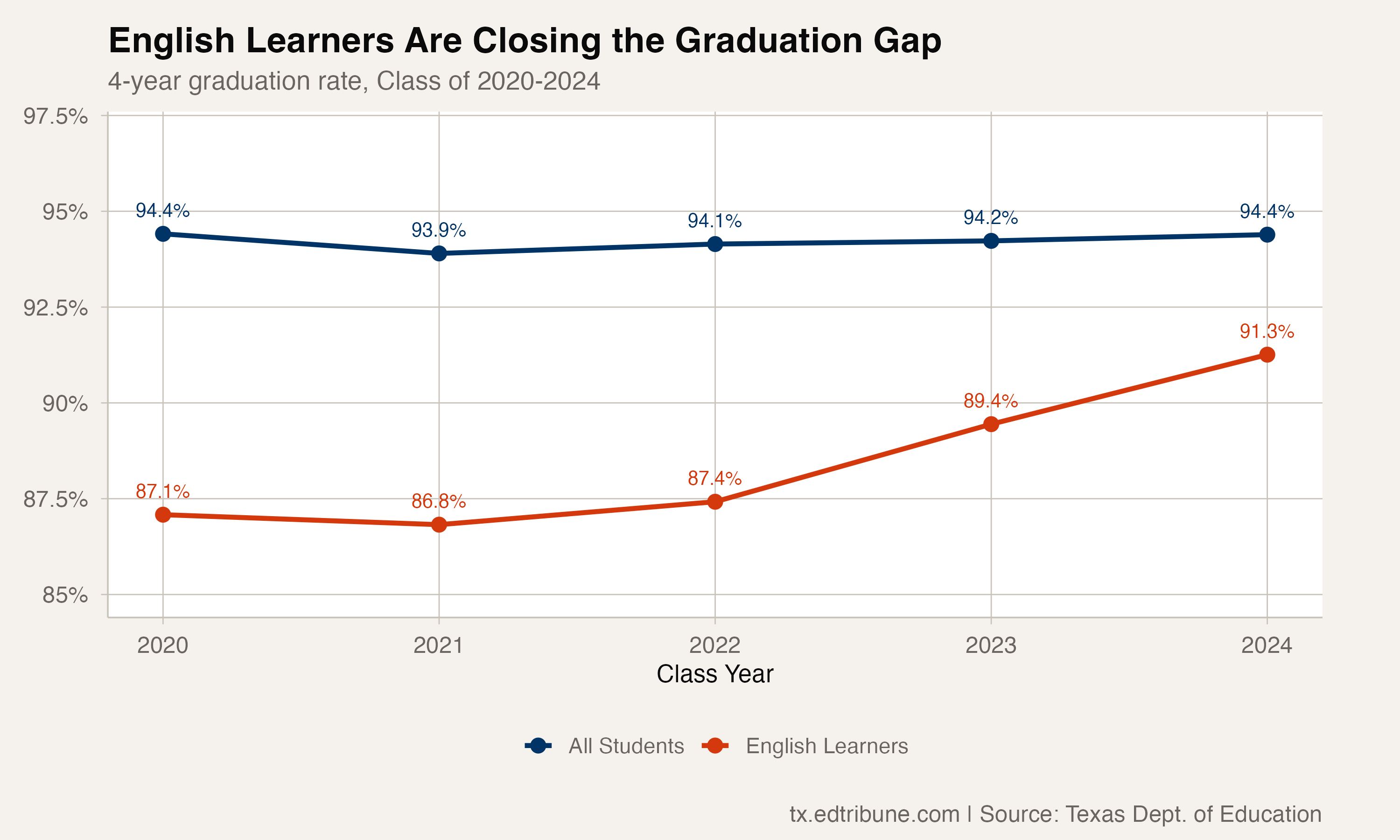
The improvement was not evenly paced. For the first two years, English learner graduation rates moved little, rising from 78.1% to 79.8% for the Class of 2021 and holding at 79.9% for the Class of 2022. Then something shifted.
The Class of 2023 brought a 2.7-point jump to 82.6%, and the Class of 2024 added another 3.1 points to reach 85.7%. The two largest annual gains in the five-year series both came at the end. In those two years, English learners gained more than 5.5 points, most of the four-year improvement.
Whatever drove the improvement, it accelerated after 2022. Possible explanations include the maturation of dual-language programs that Texas has expanded aggressively over the past decade, the return of face-to-face instruction that is especially critical for language learners, and targeted intervention programs funded through pandemic-era federal relief dollars.
Leading the pack
No other subgroup came close. Native American students gained 3.3 points over the same period, students in special education gained 2.0, and students identified as at-risk gained 1.8. Hispanic students, who overlap significantly with the English learner population, gained just 0.7 points.
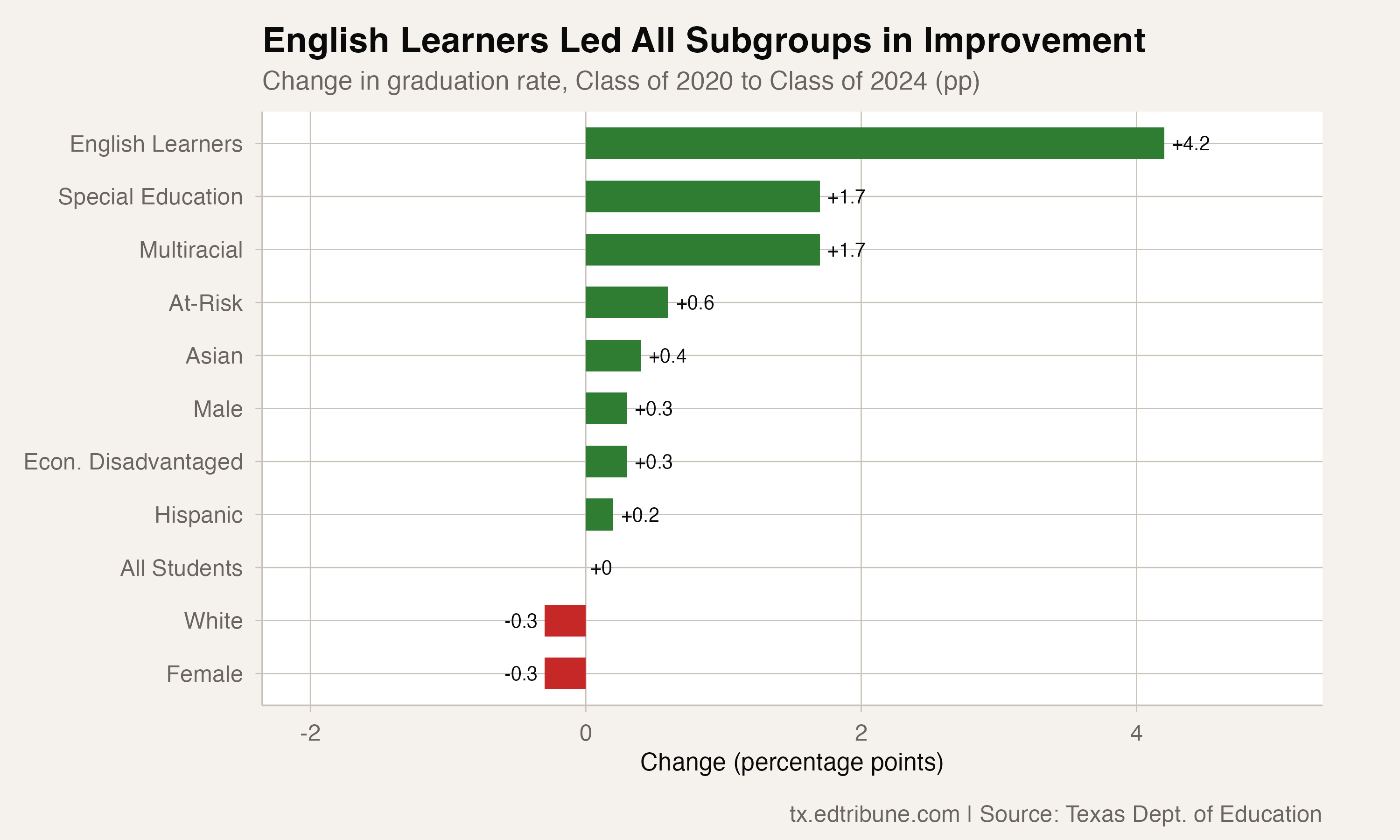
The divergence between English learners (+7.6 points) and Hispanic students (+0.7 points) is notable because the populations overlap. Many English learners are Hispanic, but the reverse is not true. Not all Hispanic students are English learners. The fact that English learners outpaced the broader Hispanic population suggests the improvement is driven by something specific to language programs or bilingual support, not a demographic tide lifting all boats.
White students gained 0.4 points and female students slipped 0.2. Asian students, already near the top at 97%, gained 0.5 points. The overall state rate rose just 0.4 points.
The district picture
At the district level, the English learner improvements were dramatic in mid-size districts across the state. San Marcos CISD saw its English learner graduation rate jump from 61.3% to 86.9%, a gain of 25.6 points. Anna ISD climbed from 71.4% to 96.8%. Somerset ISD went from 62.5% to 87.8%.
Many of the largest gains came in districts outside the major metros, in places where small English learner populations can produce large percentage swings. But the trend held in larger districts too, most notably in Dallas ISD, where the English learner rate rose from 71.6% to 82.5%, a gain of 10.9 points.
What 5.0 points means
A graduation gap of 5.0 percentage points between English learners and all students is modest. The gap for English learners is often among the widest in a state's data, sometimes running to double digits. Texas's gap was 12.2 points in 2020, itself already narrower than in many states. At 5.0 points in 2024, English learners are graduating much closer to the overall student body, though a gap remains.
Whether the gap continues to close depends on whether the forces driving the 2023-2024 acceleration are sustainable. Federal relief dollars are running out. Dual-language programs take years to show graduation effects. And the Class of 2025 will be the first cohort to have spent their entire high school career in the post-COVID era.
Detailed code that reproduces the analysis and figures in this article is available exclusively to EdTribune subscribers.
Discussion
Sign in to join the discussion.
Loading comments...