
Ronni LeeAnn McGraw named the enrollment pattern at Spearman ISD↗ET before anyone put a chart in front of it.
"Enrollment at Spearman ISD has seen a steady, multi-year decline, and looking ahead to the upcoming school year, I anticipate a similar shift—reflecting a slight decrease from last year," McGraw wrote in response to written questions from The TXEdTribune.
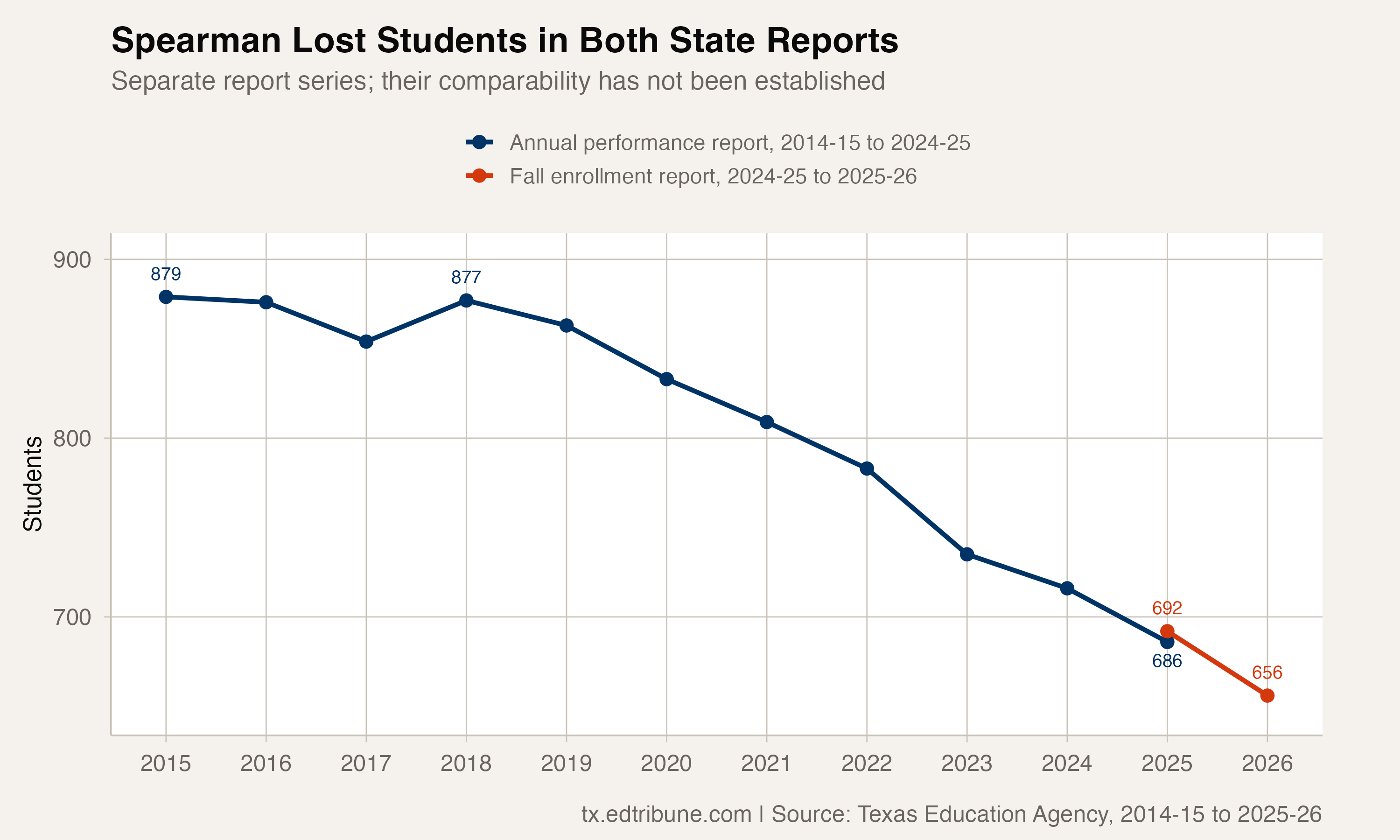
The state's published record says the same thing. Spearman ISD enrolled 656 students in 2025-26, last school year and the most recent published year in the state reports used here. In the state's annual performance reports, the district counted 879 students in 2014-15 and 686 in 2024-25, a loss of 193 students, or 22.0%, with a drop in each of the last seven of those years. Texas publishes 2025-26 enrollment in a separate state report. The reports give different totals for the overlapping year, and their comparability has not been established here, so the newest annual change compares figures from the same report: 692 students in 2024-25, then 656, a further drop of 36, or 5.2%.
"My first day in the district was July 1, 2026," McGraw wrote. The Spearman ISD board hired McGraw at its June meeting; the board's June 9 agenda carried an item to hire the superintendent and approve the superintendent contract. McGraw took over on July 1 from James Layman, who led the district through the 2025-26 school year.
What drew McGraw to Spearman was not the enrollment line.
"I was drawn to Spearman ISD by the incredible community support and the district’s well-rounded success across academics, band, UIL, and athletics," McGraw wrote. The answer went on to praise the district's academic rating, its financial position and its buildings, and then the town itself, with its brick streets and local shops. Those are McGraw's characterizations rather than figures from the state record. On the buildings, McGraw was specific: "While the facilities are older, they are remarkably well-maintained."
A decade of decline the state did not share
Over the same decade, Texas grew. In the state's annual performance reports, public schools statewide enrolled 6.0% more students in 2024-25 than in 2014-15. Indexed to the same starting point, the two lines separate almost immediately and never come back together. In 2025-26 the state as a whole dipped too, by 1.4% in the newer report, but Spearman's drop that year was several times as steep.
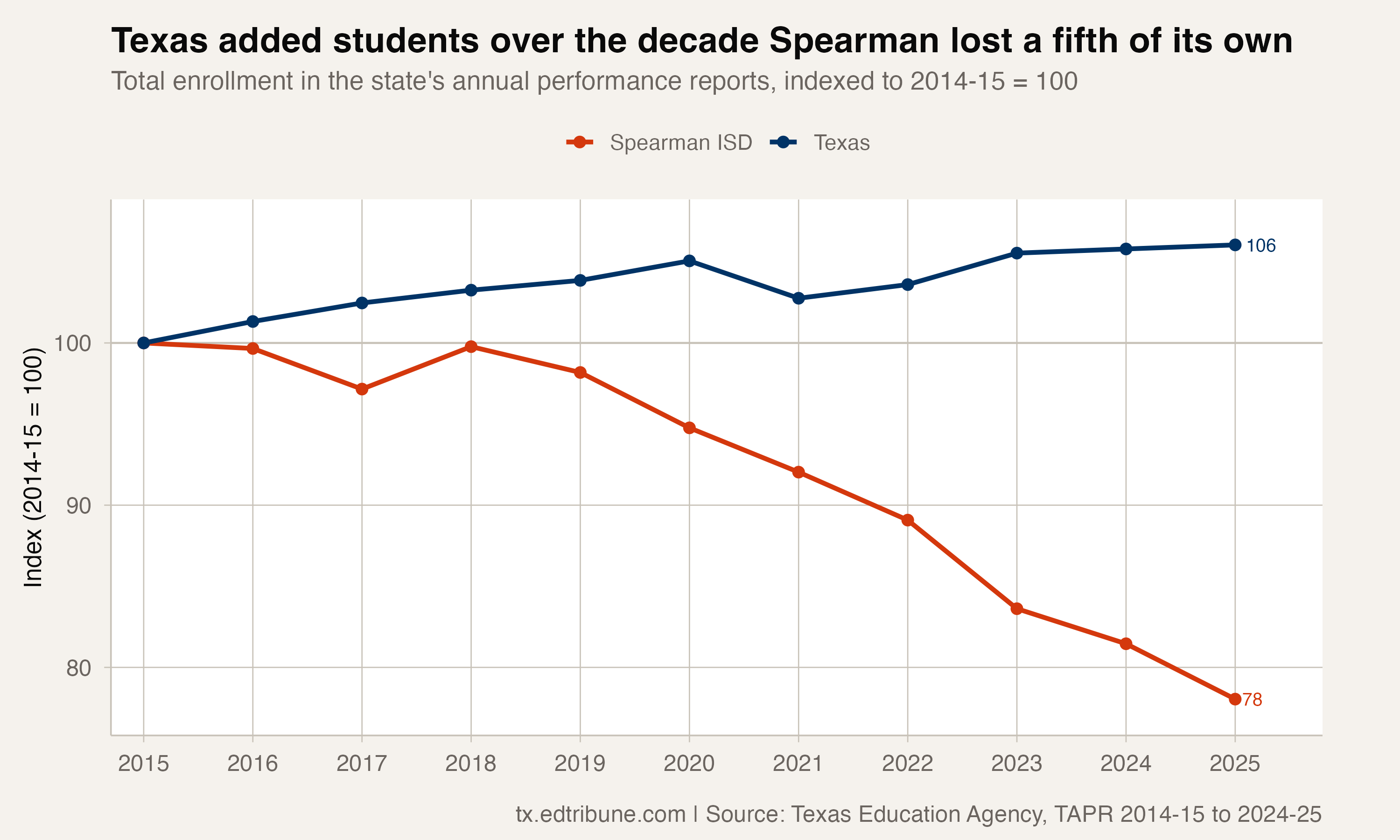
That is the landscape rather than a verdict. A district of 656 students in the northern Panhandle is not the Texas average, and the state record establishes the movement without explaining it. It does not show whether a family moved to another district, moved out of the region, or simply never arrived because there were fewer children in Spearman to enroll.
One group did not follow the total down
Inside the shrinking total, one population held its ground. The state counted 187 Spearman students as emergent bilingual in 2014-15 and 181 in 2024-25, the most recent year Texas published that count for the district. Six fewer students, against the 22.0% drop in total enrollment over the same span.
Measured as a share of the district, that is a rise from 21.3% to 26.4%, or 5.1 points. Emergent bilingual is a service designation that overlaps race, income and every other category, so the share describes how much of the district needs that support, not a separate slice of it.
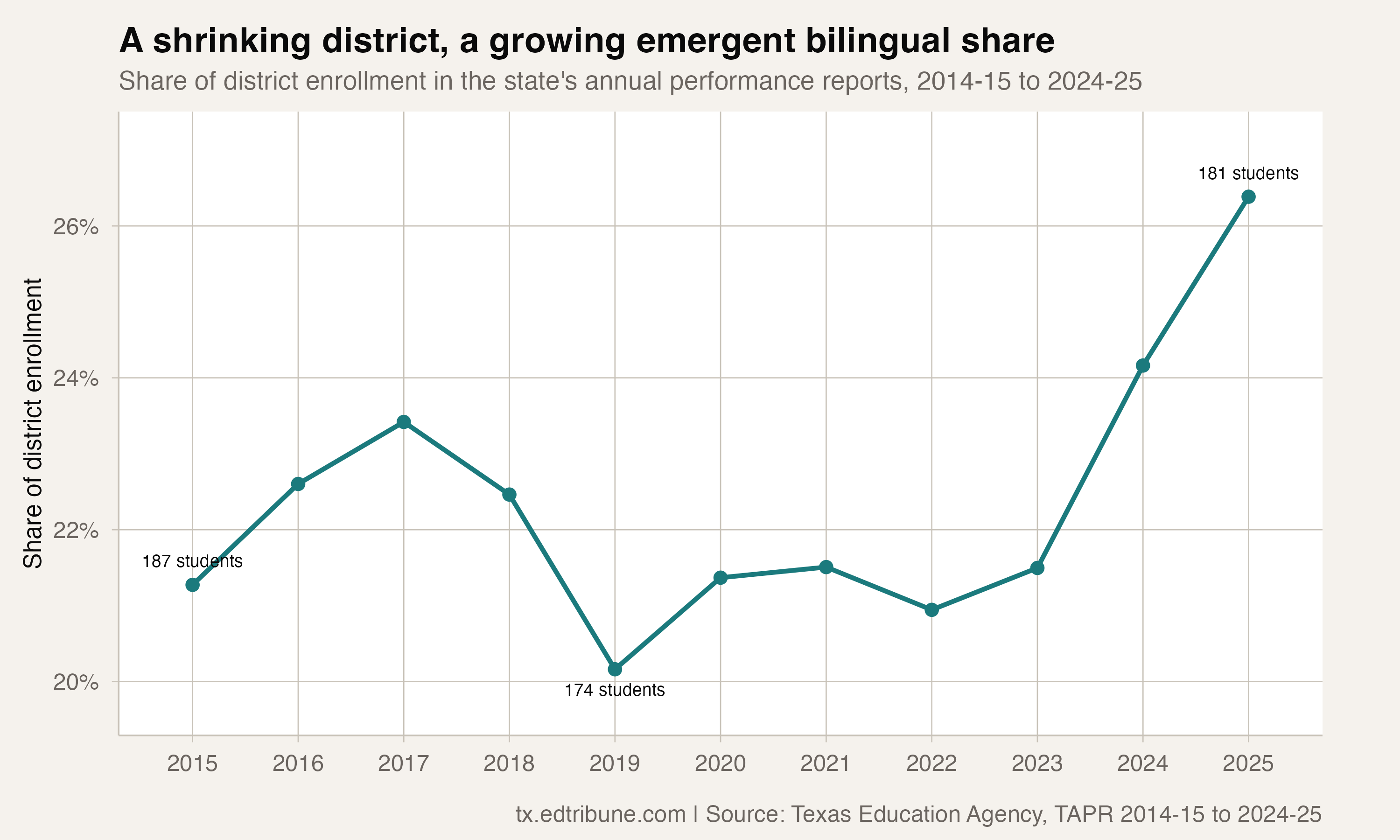
The state's 2025-26 enrollment report carries no emergent bilingual count, so the series stops at 2024-25 rather than carrying a number forward. For scale on the district's composition, 468 of the 656 students enrolled in 2025-26 were reported as Hispanic, representing at least 71.3% of the published district total. Hispanic and white are the two categories with published counts, together accounting for 98.8% of that total. The remaining 1.2% is unaccounted for in the published category counts; those shares are lower bounds. The report does not establish why that gap exists.
McGraw put that group at the center of the first-year plan without being asked about it. Under student achievement, the priority was "Aligning our curriculum and refining instructional practices, with a focused emphasis on raising academic outcomes for Emergent Bilingual (EB) and Special Population student groups." Under a longer answer about enrollment strategy, it came back again as "Providing tailored educational support in critical areas—with a strong focus on expanded resources for our Emergent Bilingual (EB) students—to meet unique learning needs and draw families from surrounding areas."
A plan aimed at the trend line
McGraw was direct about the goal. "However, my goal is to actively turn those trends around. I plan to reshape how neighboring communities view Spearman ISD by positioning our district as a premier destination for students," McGraw wrote.
Two of the remaining first-year priorities are relational. One is "Building strong, collaborative relationships with community leaders, local pastors, and school staff to directly support student success." The other is "Elevating administrative and instructional leadership across the district by actively mentoring principals and teachers." The remaining one returns to the buildings McGraw praised on arrival: "Enhancing the facilities and maintenance departments by updating structures and streamlining operational processes."
Asked what families and staff most want the district to keep doing well, McGraw cited community feedback and named three things. The first was "Maintaining the strong sense of community, tradition, and local pride that defines Spearman schools." The last was about enrollment again: "Sustaining momentum to make the district an attractive choice for families, aiming to boost enrollment and draw new students to the community."
Those two answers sit in some tension, and McGraw did not pretend otherwise. Families are asking the district to protect what Spearman already is. The enrollment plan asks it to look like a destination to families who live somewhere else.
What the next count will show
The most recent published year moved down by 36 students, or 5.2%, from 692 in the same state report. Every enrollment figure used here comes from a published state report through 2025-26. These comparisons describe last school year and earlier years, rather than enrollment in 2026-27, the year now underway.
When that count arrives, it will be the first one taken entirely during McGraw's tenure, and the first test of a strategy that has to work on families in surrounding towns before it shows up in a Spearman classroom. McGraw has already said what to expect from it. The harder question is what the year after that looks like.
Enrollment figures for 2014-15 through 2024-25, including emergent bilingual counts, come from the Texas Education Agency's annual performance reports. The 2024-25 and 2025-26 figures compared with each other, and the 2025-26 race counts, come from the agency's student enrollment reports. Ronni LeeAnn McGraw answered The TXEdTribune's questions in writing and supplied the professional headshot.
Detailed code that reproduces the analysis and figures in this article is available exclusively to EdTribune subscribers.
Discussion
Sign in to join the discussion.
Loading comments...